ISmall-Business.net

Intelligent Business Solutions

  • Home
  • Strategy
    • Small Business Strategy
      • Combining Niches to Maximize Profit Potential
      • High Ticket Versus Volume Niche Selection
      • How to Know When to Cut a Business or Niche Loose
      • Never Put All Your Eggs in One Basket
    • Sales Strategy
      • Facebook Networking Versus Paid Advertising
      • Brainstorming a Successful Sales Funnel
      • Best Practices for Profitable List Building
      • Backend Sales Strategy Tips
      • A Better Way to Use Webinars for Profits
      • Creating a Welcome Email That Makes Money
    • Production Strategy
    • Human resource strategy
  • Management
    • Business action plan
      • 7 Things to Send JVs to Get Them Onboard
      • Don’t Make JV Promises You Can’t Keep
      • How to Host a Challenge and Maximize Profits
    • Small Business Management
      • Putting Profit Tasks First During Time Management
      • How Self Doubt Sabotages Your Financial Success
      • Repurpose Your Content to Save and Make Money
    • Business Management Topics
      • Fighting the Stigma of Failure
      • Figuring Out the Perfect Launch Date and Time
      • Bonus Creation That Catapults You to Leaderboard Domination
      • Do Customers Prefer Video or Text Courses
      • Minimize Your Risk of Refunds with These 5 Tips
      • How Often Should You Email Promo Material
      • Narrow Niche Domination
      • Perfecting the Launch Process for Increased Profits
    • Business Management Blogs
      • Nobody Expects a Perfect Expert
  • Ideas
    • Find business ideas
      • 5 Lucrative Non IM Niches
      • 6 Niches That Are Hot on Social Networks
      • Are PLR Stores a Viable Way to Make Money
      • How to Know If a Membership Site Is Right for You
    • Idea feasibility
      • How to Make Money Off a $7 Product
      • Recurring Income Options
    • 10 top business ideas
      • Could Coaching Bring in More Money Than Products
      • Individual Coaching Versus Group Coaching Profits
      • Building a Reputation as a Powerful Affiliate
      • Pinterest Profit Niches
    • Low cost business ideas
      • Making Money Off eBooks and Reports
  • Valuation
    • Business Valuation
    • Increase business valuation
      • Making Wise Investments in Tools to Further Your Business
    • Business Valuation Methods
    • Understand business valuation
  • About
    • About Me
    • Blog
    • Contact Us
    • Sitemap
    • Privacy Policy
  • Strategy
  • Supply Chain
  • Customer Focus
  • Entrepreneur
  • Biz Opportunities
You are here: Home / Archives for Asif Nazeer

5 Tips to Help Marketers Win in What’s Shaping up to Be the Future: Voice Search

July 17, 2019 by Asif Nazeer Leave a Comment

[ad_1]

Over half of consumers, one study revealed, have used voice search to find local business information within the last year. Doesn’t that tell you where “search” is headed?


July
17, 2019

4 min read

Opinions expressed by Entrepreneur contributors are their own.


Every day, millions of Americans rely on voice-activated devices to tell them the weather, wake them up in the morning and answer a plethora of random questions they’re curious about. While the average voice assistant user may not worry about where those answers come from, digital marketers are working hard to ensure that voice devices rely on information from their sites to inform the answers people receive.

Related: 3 Ways Entrepreneurs Can Position Their Brand to Dominate Voice Search

And for good reason. Over half of consumers, according to a data roundup by Bradley Shaw, have used voice search to find local business information within the last year, and a quarter (27 percent) actually went on to visit the company’s website after conducting a voice search.

Voice is an increasingly common avenue for engagement between brands and consumers, and marketers must fight hard to rank high as a source of information within the voice realm. Here is what they need to know:

Five key ranking factors

Because voice-activated technologies are relatively new, marketing strategies designed to make use of voice devices are often undefined.

However, certain ranking factors (i.e., the factors that determine how high a web page ranks on Google’s search engine results page) do guide voice searches the most.

According to research by my own company, SEMRush, nearly 80 percent of the answers voice assistants provided for our searches ranked among the top three organic results, and 97 percent of the answers provided by Google Assistant ranked among the top 10 organic results.

Therefore, marketers seem to be prioritizing a first-page ranking before even considering a ranking for voice search queries.

Here are additional factors marketers should consider, which affect the ranking factors behind voice searches:

Featured snippets: The pictures and blurbs that help illustrate answers to search queries are essential when companies rank for voice searches. In fact, nearly 70 percent of all voice answers come from featured snippets, according to our study. To rank high for voice search queries, marketers should optimize pages to take advantage of this increasing phenomenon.

Related: Why Do Businesses Need to Optimize For Voice Search

Average word count: The average length of a voice search answer is 41.4 words. For example, Google Home has an average word count of 41.4, and, with the Mini version, 42 words. So, keep the answers on your search-page results at around 40 words or you’ll risk being outranked by competitors that do.

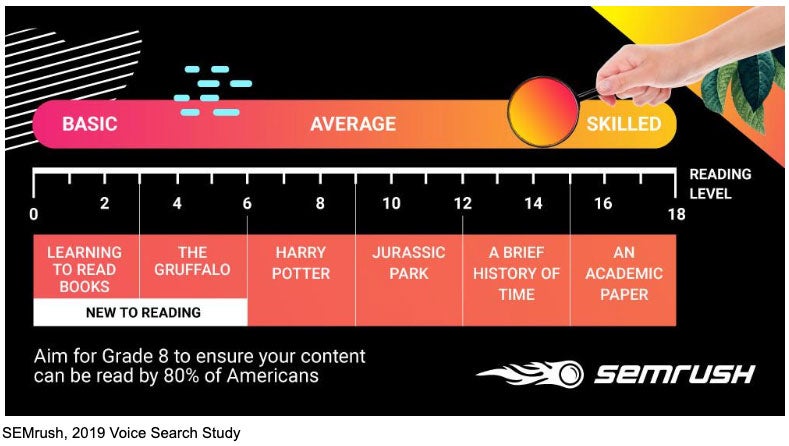
Readability: Search engines look for well-structured, well-written content that ultimately matches the intent of the query. This means that the readability of a page’s content is a key factor for ranking high on the results page. In general, the results from voice searches are understandable to the average 15-year-old, according to the Flesch Kincaid reading level test.
Page speed: The faster that results load, the better. For the majority of questions asked via voice, Google chooses an answer that loads faster than the average page on the search engine results page. In some cases, answers for Google Home voice searches have a page speed 10 times faster than the rest of the options found on the first page, making page speed one of the biggest factors in ranking for voice search.

Backlinks: Backlink anchors matching users’ search queries are found in 50 percent of answers for Google Home and Mini. Likewise, keywords in the title of the result are found in over a third of voice answers, a fact that offers increased opportunities for marketers to put their page results in front of target audiences. However, backlinks play a less significant role in voice searches conducted via smartphone devices, so marketers interested in mobile should be sure to blend backlinks with the other strategies listed above.

Search engine optimization (SEO) tactics are always evolving, and marketers must proactively learn new skills to stay ahead of their competitors and earn valuable web traffic from voice searches.  

While the world has not completely transitioned to voice search, there’s no denying that consumers are quickly moving in that direction. In fact, by 2020, eConsultantcy has predicted, 50 percent of all searches will be conducted using voice.

Related: How Entrepreneurs Can Take Advantage of Voice Search Marketing

To stay ahead of search trends, start by using SEO tools to determine how a website ranks. Then, layer on upgrades in key areas like page speed, ranking in the top three results and occupying a featured snippet position. SEO strategies can take several months to yield results, so it’s important to get started now and prepare for a future where voice searches will be the norm.

[ad_2]

Source link

Filed Under: Entrepreneur

Level setting

July 17, 2019 by Asif Nazeer Leave a Comment

[ad_1]

In his new book, The Levelling, author Michael O’Sullivan looks back to 17th-century England to sketch a road map for how the world can create institutions and economic arrangements that will drive the next phase of globalization.

[ad_2]

Source link

Filed Under: Strategy

New TaxWise Mobile App Helps Preparers Keep in Touch Clients

July 16, 2019 by Asif Nazeer Leave a Comment

[ad_1]

The big five accounting firms get most of the attention in the industry. But they only make up 10% of the firms in the U.S. Overall, 90% of these accounting firms have 10 or fewer owners or partners.

Wolters Kluwer Tax & Accounting designed its new TaxWise Mobile app for tax preparers. These preparers have a heavy focus on individual tax returns and thus a very seasonal business. As a result, the company says the mobile interface will streamline tax preparation for this particular group.

For example, small firms compete with their large counterparts by providing personalized services. And this requires being available at all times.

So when a CPA ventures out of the office, providing access to their clients’ information becomes a personalized service. And on the client side, making remote options available to securely fill out and send their tax forms becomes equally important.


Wolters Kluwer TaxWise Mobile App Helps Preparers Keep in Touch With Clients


Accessibility

Global company Wolters Kluwer provides professional information, software solutions and services. It specializes in the health, tax and accounting industries. And it also figures prominently in the finance, risk and compliance, and legal sectors that support public and private enterprises

The company is bringing this experience and infrastructure and making it available more available for firms of all sizes. This includes meeting the strict compliance in place for storing and transmitting financial data online.

In the press release, Shannon Bond, Vice President, Preparer Segment, Wolters Kluwer Tax & Accounting North America, address this very point. Bond says, “Wolters Kluwer is expanding our expert compliance capabilities with technologies that enable an end-to-end mobile experience for high volume, seasonal tax preparers. TaxWise Mobile helps tax preparers reach more clients, where they are, which is critical in today’s mobile society.”

The new TaxWise Mobile solution is fully integrated with TaxWise Online for end-to-end remote return preparation.

As a client, TaxWise Mobile is going to allow you to complete the tax preparation process from virtually anywhere. You can use your smartphone, computer, or tablet and not have to visit an office.

The app lets you fill out your information, upload documents, and review the prepared tax return. You can then sign the document and send it to your CPA for electronic filing. After it is complete, you can use TaxWise Mobile to check the status and any refund updates.

For the Preparer

With this application, your clients can fill out critical information and upload documents from their preferred mobile device. This includes adding images of their tax documents and E-signatures. The information then goes into the TaxWise Online platform automatically.

As the preparer, you can also use the platform to share documents and communicate directly with your clients. Combined with the TaxWise desktop version you can offer popular refund options to simplify your workflow through integration with CCH iFirm Practice Manager.

The TaxWise Mobile app is now available.

Image: Depositphotos.com


[ad_2]

Source link

Filed Under: Strategy

Dan Lok Failed in 13 Business Ventures Over Three Years. Now This ‘Unemployable’ Immigrant Manages Millions and Mentors Young Entrepreneurs.

July 16, 2019 by Asif Nazeer Leave a Comment

[ad_1]

From thousands in debt to helping thousands around the world find success.


July
16, 2019

8 min read

Opinions expressed by Entrepreneur contributors are their own.


At just 20 years old, Dan Lok was already $150,000 in debt. Over three years, he launched 13 businesses — and every single one of them failed. Today Lok is a multimillionaire and business mentor, thanks to the help of one man and his life-altering lessons. Now he’s paying it forward.

Lok with his parents in Hong Kong, China.

Image credit: Dan Lok

Lok’s parents separated when he was 14 years old. He and his mother emigrated from Hong Kong to Vancouver, Canada, later that year. His father continued providing for them, but when Lok was 16, his father filed for bankruptcy and could no longer support them.

“I will never forget the look of hopelessness on my mom’s face and the tears in her eyes,” says Lok. “At that moment, I decided that I would be successful. I didn’t need my dad; I would provide for my mom. I never wanted to see that look again.”

His mother had limited work experience, so Lok supported them by working part-time at a grocery store for minimum wage. After a year, he learned an enlightening lesson: “I was told that I was unemployable because I don’t like being told what to do. I cannot disagree with that statement,” he smirks.

Stocking shelves was Lok’s first and last “traditional” job.

Losses with lessons.

Lok began mowing lawns, delivering papers, and doing anything that had a remote possibility of making money. After high school, he enrolled at Douglas College in Vancouver. He attended full-time business classes while cycling through one failed entrepreneurial idea after another — from vending machines to delivery services and day trading.

Lok maxed out several credit cards and borrowed from everyone he knew. “No one understood why I didn’t just get a job,” he says. “But I knew that I could never repay my debts and provide for my family by working for the minimum wage. I knew I would be better off as an entrepreneur, even if it took a decade. I never gave up because I couldn’t afford to quit — and if you don’t quit, then you can’t fail.”

Lok calls those ventures “losses with lessons.” He acknowledges that most people would have quit somewhere between their first and thirteenth attempt. His response? “Success is on the razor’s edge of failure. When you think it can’t get any worse, hang on just a little longer.”

Picking up trash for mentorship.

After Lok read Claude Hopkins’ book, “Scientific Advertising,” he became obsessed with marketing and soon discovered marketing expert Alan Jacques. Lok studied his sales letters and attended his seminars, where he met Jacques in person.

Lok offered to buy Jacques lunch, and they talked for hours. When Lok asked to be his mentee, Jacques declined, but Lok wasn’t discouraged. “I visited his office every day for about a month. I did everything possible to demonstrate my willingness to help — including picking up trash around the office — until he finally hired me.”

Lok dropped out of college to work for Jacques. The 21-year-old spent weeks crafting his first sales letter, only for Jacques to tell him it was terrible. Lok rewrote it seven times before Jacques was satisfied. Jacques later confessed that the first draft was “OK” — but “OK” isn’t how you master anything.

Though Lok didn’t earn much money, he says the 12-month mentorship with Jacques was his first “million-dollar year.” Under Jacques’ guidance, Lok started a one-person advertising agency, and within 12 months his clients were generating millions of dollars from his sales letters. By 22 years old, Lok commanded $10,000 per project and was comfortably earning six figures.

Worthwhile struggles.

“I could finally provide for my mom. I didn’t have to go to the ‘nearly expired’ section of the grocery store anymore,” says Lok. “The mentorship from Alan truly changed my life. That’s why I choose to mentor young entrepreneurs each and every day.”

Several years later, Lok returned to Hong Kong for the first time to visit his father, who was getting by but worried about having a place to live. Walking down the street, Lok stopped and pointed to a window. He pulled out a set of keys and said, “I bought that apartment for you.” The look on his father’s face made all the struggles worthwhile.

Lok invested the profits from his online business into real estate and became a millionaire at age 27. Since his businesses could run without him, he retired as well and set off to “live the dream.” He sat on the beach nearly every day for a month, then spent the next month watching six movies a day. After two months of retirement, he’d had enough.

Lok began sharing his knowledge with a self-published marketing manual, “Forbidden Psychological Tactics.” In a quest to sell the manual, Lok mastered online marketing. He went on to become an accomplished affiliate marketer, sell informational products, and create copywriting software.

Over the next decade, Lok founded or partnered in more than 15 companies in industries ranging from beauty salons to e-commerce. Today their combined sales exceed eight figures annually. Lok attributes this success to three things he lacked early in his career: mentorship, focus, and “high-income skills” like copywriting, marketing, and public speaking.

His biggest regret and motivation.

When his father had a stroke, Lok was in the U.S. chasing his biggest deal yet. “I wanted to make my dad proud, so I told him I’d be with him as soon as I finished. That was the last time I spoke to him. I never got to say goodbye, and it’s my biggest regret.

“I realized that chasing money and achievement wasn’t making me happy. Suddenly it all meant a lot less.” Lok’s motivation shifted from providing for his family to providing opportunities for others around the world. Now his mission is to impact 1 billion people by teaching them how to develop high-income skills, unlock financial confidence, and master their economic destinies.

Lok invests significant time teaching others on his social media channels, where he has 4.5 million followers at the time of writing, and on his podcast, “The Dan Lok Show.” Through his video series and programs like “Dan on Demand” and “Tube Your Own Horn,” Lok teaches others to grow their businesses with social media. He has penned over a dozen books, including his latest, “Unlock It!” which hits bookshelves with ForbesBooks in September 2019.

Lok also offers coaching, masterminds, and masterclasses. He teaches sales and other business skills through his High-Ticket Closer Certification Program and Inner Circle mastermind. His project, Closers.com, then matches companies with the high-ticket closers he has trained.

“It’s an entirely holistic method,” says Lok. “I’m proud of all of my students and their success, and it brings me joy to offer them a platform to continually enrich themselves, financially and otherwise. I’ve even hired graduates of my High-Ticket Closer program to work for me in my personal business.”

Lok with 1,000 graduates from his High-Ticket Closer Certification Program.

Image credit: Dan Lok

Lok’s wife, Jennie Li, has been there through it all as his chief strategy officer. After meeting at a karaoke place when Lok was 26, they started dating and working together before getting married in 2015.

“Her intuition and instincts are unmatched,” says Lok, who adds that she keeps him humble. “I remember coming home after giving my first TEDx speech. I’m in a red suit, on top of the world, and Jennie tells me to take out the trash. I love that.”

Though Lok is an international speaker who enjoys wearing flamboyant suits, he still remembers his roots. “Who would’ve thought a poor immigrant boy could accomplish so much?” he asks. “No matter where you’re from or what obstacles you’re facing, you can accomplish anything too — if you never give up.”

Connect with Dan on YouTube or read his latest book, “Unlock It!” (ForbesBooks) when it hits bookshelves in September 2019.

[ad_2]

Source link

Filed Under: Entrepreneur

2019 Marketing Tips and Tools for Online Businesses – Online Businesses

July 16, 2019 by Asif Nazeer Leave a Comment

[ad_1]

Featured image from Pixabay

Online businesses have benefited in 2019 from using more effective marketing tools. These tools help them to grow revenues, expand operations, and increase profitability. In this post, we share about those tools and describe how businesses like yours are using them.

Think of Social Media as a Marketing Tool

Take social media for example. What began as a novel concept rapidly transformed into a pervasive and indispensable marketing tool. Today, an estimated 70% of Americans actively engage with social media on a daily basis. Back in 2005 this number was just 5%.

Businesses are eager to cash in on the latest marketing trends, and they conduct much of their communications with their target market via social media. By implementing an effective social media marketing strategy, your business, too, can reach ever deeper into the global online marketplace. This will help you to grow a diversified audience, generate and convert more leads, drive sales growth and performance, and stay up-to-date with the real-time pulse of the people. Clearly, social media is powering the narrative as the premier marketing tool for online businesses.

Consider the following social media statistics:

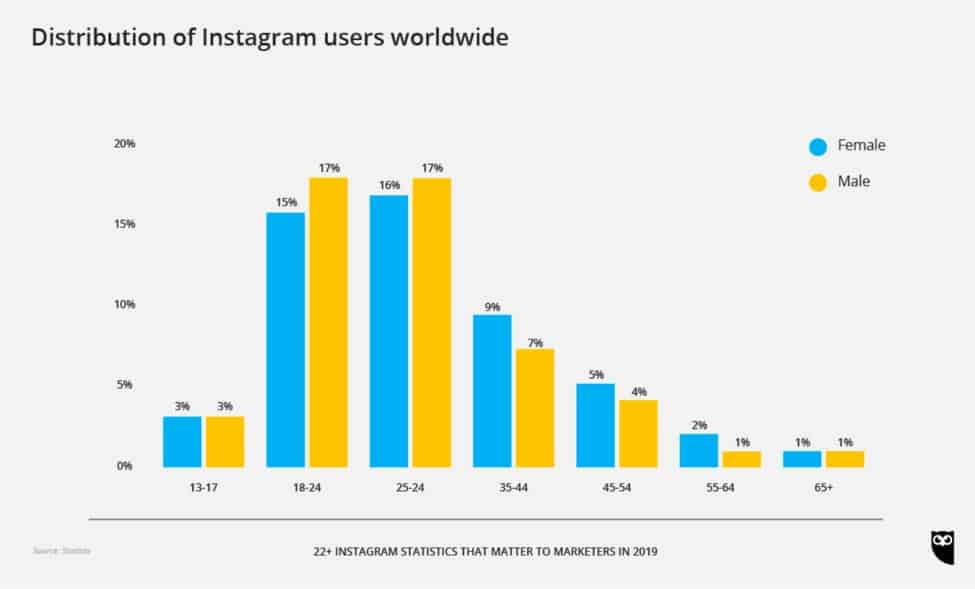
Source: Statista Instagram Users Globally (Male & Female)
  • One billion people use Instagram every month, and 500 million people use Instagram daily. What’s more, 88% of Instagram users are located outside of the US. This means that Instagram is a truly global social media marketing tool. Here’s another interesting statistic: 71% of Instagram users are younger than 35 years of age. And there is a near-even split of users between the sexes.
  • Additionally, 95% of Instagram users in the US also use YouTube; 91% use Facebook, and 60% use Snapchat. While just 35% of Americans currently use Instagram, 68% use Facebook and 73% use YouTube. The Pew Center reports growing interest in Twitter at 24%, LinkedIn at 25%, and Snapchat at 27%.
Marketing tools 3
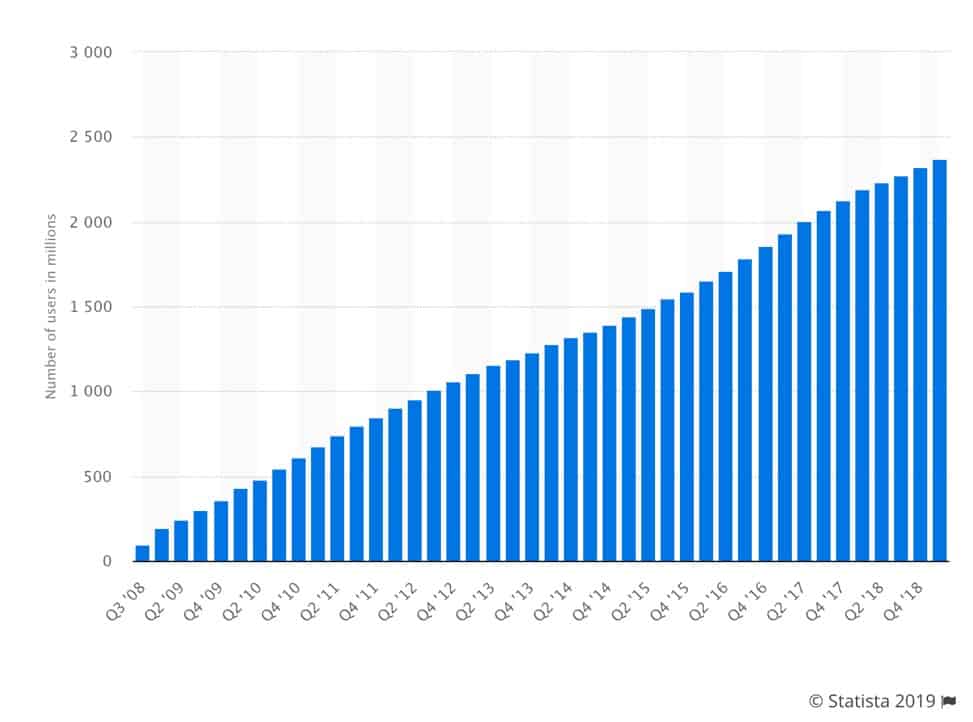
Source: Facebook User Stats Statista 1st Quarter 2019
  • Global usage of Facebook between 2008 and 2019 indicates a substantial increase in the number of users. For example, by Q1 2019, the number of Facebook users topped out at 2.38 billion monthly active users (MAUs). It’s important to point out that Facebook owns multiple social media platforms. They include Messenger, Whatsapp, and Instagram. These social media platforms dominate the landscape, particularly with the highly effective Facebook marketing campaigns.
  • By contrast, Twitter boasts 326 million MAUs. Moreover, there are 100 million daily active users (DAUs) on Twitter. Plus, people send 500 million tweets daily. With 261 million Twitter users outside the US and 69 million Twitter users in the US, this social media platform is the premier microblogging platform in the world. Businesses routinely use Twitter to get real-time news updates out to their customers.

2019 Trends in Digital Marketing Tools

Given the significance of social media as a powerful marketing tool, it makes sense that online businesses are investing heavily in global online ads. According to the stats, 2019 ad spend is expected to rise by 4.7% for 2019. Additionally, location-based marketing initiatives are expected to grow by 14%, reaching $24.4 billion in ad spend this year alone.

Plus, influencer marketing is hogging the limelight in 2019. For example, 43% of advertisers announced big budget allocations toward influencer marketing initiatives for the year.

Additionally, Snapchat has become a popular choice for digital marketers in 2019. The average Snapchat user now generates $1.68 in revenue for 2019, compared to $1.21 in 2018. One of the most promising social media hubs on the scene is TikTok. Advertisers are plenty interested in this new app. That’s because it had already generated $9 million in sales by May 2019. Moreover, marketing experts expect it to produce $100 million in sales as the year progresses.

Effective Content Marketing Strategies Drive Sales

Content truly is king. This was true back in the day, and it’s true in 2019. Content marketing managers understand that premium-value content is worth its weight in gold. Content marketing via blogs, website platforms, product pages, social media sites, newsletters, webinars, seminars, podcasts, and so on are highly valuable. High-quality content conveys a value proposition to customers, who then purchase goods and services. Moreover, they share ideas and add value to the transaction process.

Email Is a Powerful Marketing Tool

Part of the content marketing initiative involves email marketing. In 2019, email marketing is a central component of the marketing process. Email marketing is a cost-effective tool that generates leads and drive sales. And it also facilitates predictable results for businesses.

Marketing experts readily attest to the fact that with email marketing, the business owns the network. Unlike Facebook, which requires businesses to pay for the privilege of sharing posts with a wide audience, email marketing puts businesses in control of their marketing strategy.

RELATED ARTICLE: EMAIL VALIDATION: GIVING YOU MORE ROBUST AND EFFECTIVE EMAIL CAMPAIGNS

Take a Hands-On Approach

This means you can take a hands-on approach to building a valuable asset. It begins with constructing an email database, born from a subscriber list of contacts and clients. Of course, it’s imperative that each person on your email list has granted you permission to contact them in this way. Otherwise, your emails will be relegated to the spam filter.

Marketing managers have fine-tuned this technique by limiting email marketing to just one message every week or two.

Using Effective Tools to Drive Marketing
Results

In 2019, marketing experts are using various tools to generate effective results. These include a combination of high-quality software tools such as Hootsuite, Hubspot, Social Oomph, Sendible, and Sprout Social. However, given that many marketing tools are redundant, experts conduct processes to bring more efficiency to these marketing tasks.

These tools save time, money, and manpower by automating and consolidating activities. Additionally, they reduce the likelihood of error by way of optimal performance strategies and advanced analytics.

In other words, marketing tools span the full spectrum. That is, they include social media, content marketing, and email marketing channels.

Turn to Enticements to Engage Your Customers

Various multinational corporations are also turning to enticements to drive home their marketing message to customers.

For example, incentive-based marketing communications such as special offers, bonuses, promotions, and gamification of marketing offers abound. The 888 casino no deposit bonus is a case in point. This global gaming phenomenon consistently ranks atop the pile of reputable online casino providers.

The success of 888casino is largely attributed to its unique marketing initiatives. Bonuses and promotional offers are enticements designed to make it worthwhile for players to register, deposit, and play. By wooing players to register, this online casino has found the “elixir” to marketing success in 2019.

Marketing Tactics Must Serve Marketing
Objectives

marketing tools 4
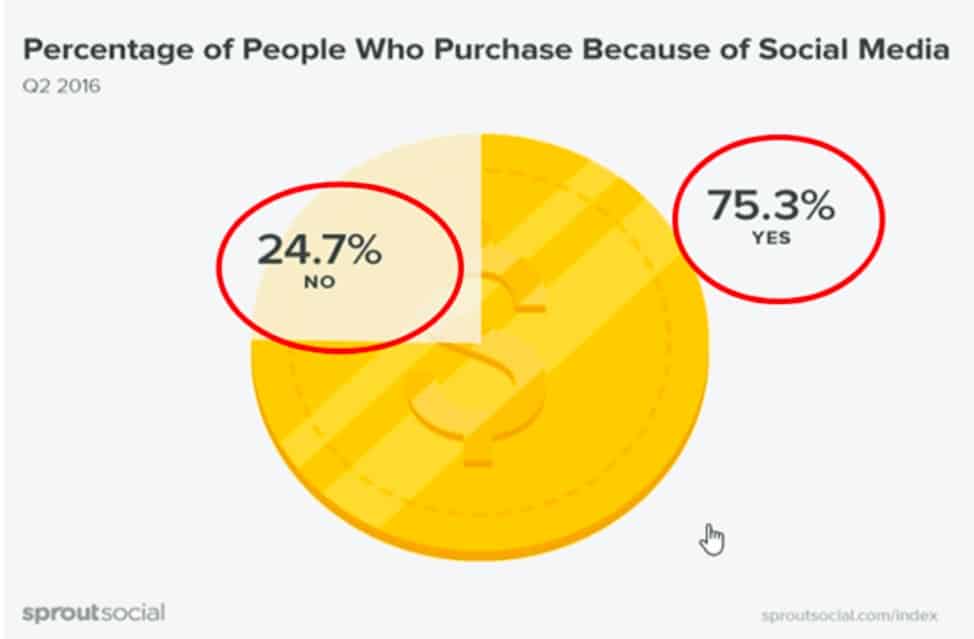
Source: Sprout Social

Tactical activities are short-term objectives. Typically, these are day-to-day activities. On the other hand, marketers measure strategic objectives over the long term.

Successful implementation of marketing strategies requires the establishment of a sound plan of action. In the words of management guru David H. Levy, “If you don’t have a direction, any path will take your business to its destination.”

However, a clearly formulated strategy allows for contingencies with all these issues. Social media objectives, content marketing objectives, and promotional tools should work in sync to establish an efficient plan of action for your business.

This means that your social media goals must gel with your online business’s overall marketing plan. Therefore, you must write your goals down. Only in this way can you measure and achieve your goals.

Consider this: Marketing studies indicate that businesses with written goals are 30%-40% more likely to succeed. Unfortunately, however, various infographics suggest that 83% of people have no strategic goals.

Only 14% of people have strategic goals. However, these are the people who are ten times more successful. People whose business plans encompass written goals (just 3% of operations) are thirty times more successful in the long term.

Research Your Marketing Strategy

To achieve success, you must thoroughly research your marketing strategy. Moreover, your goals must be quantifiable and qualifiable.

Some metrics are more easily understood through numerical data. On the other hand, others are qualitative in terms of appeal, satisfaction, and opinion. You can garner audience insights through surveys, market research, blogs, social media platforms, customer support analytics, email, and other means. However, you’ll best achieve engagement through interactive elements such as gamification, promotional offers, contests, and social media engagement plans.

Moreover, the only way to ensure engagement on social media is through proper communication.

Marketing professionals stress the importance of knowing your target market. This involves targeting your audience with the right content at the right time. Additionally, use the right lingo to hook customers into responding to posts and offers. Match every post with a description and a functional link.

Effective social media strategies always bear fruit because they engage users. More importantly, remember that audiences are smarter today. They don’t want a hard sell. They want to partner with companies and feel invested in the products and services your business is offering.

Conclusion

Effective marketing is really about resonating with your customers. They want to know you follow their life philosophy of responsible behavior, respect for the environment, and inclusiveness. Today, companies that adopt socially responsible practices are more likely to strike it rich with their customers.

[ad_2]

Source link

Filed Under: Biz Opportunities

Analytics Platforms for Mobile App Attribution – Online Businesses

July 15, 2019 by Asif Nazeer Leave a Comment

[ad_1]

Mobile app attribution allows acquisition marketers to understand how users learn about and start using apps. This allows marketers to map out data points for specific actions users take, from clicking an advertisement to installing the app to making in-app purchases.

In this article, we look at what mobile app attribution is. Then we discuss the features you need to look for in a mobile app attribution analytics platform.

Additionally, we compare AppsFlyer and Branch, two of the most popular mobile app attribution platforms. Hopefully, this comparison will help you determine the right solution for your business.

RELATED ARTICLE: THE 10 ESSENTIAL FEATURES YOU NEED IN YOUR CRM SOFTWARE

What Is Mobile App Attribution?

Mobile app attribution is the process of identifying how and where users learn about your app. Then it allows you to map interactions across platforms. Ultimately, this lets you monitor and optimize the journeys people take to becoming your customers.

Advertising platforms can provide a good deal of data on the effects your ads have on your conversion rate. However, these platforms are more interested in reporting conversions than in conveying information that could be more useful to you.

What’s more, if you’re working in a high-growth environment, then you’re likely running campaigns on several networks at once. Therefore, there’s high value in having the ability to consolidate reporting in a single place.

Ideally, mobile app attribution allows app marketers to collect unbiased data about their return on investment (ROI) from their various marketing efforts. This data gives insight into what led a user to install your app. Also, it allows you to figure out exactly what caused a rise or fall in app installs. This information is helpful in optimizing marketing campaigns. Additionally, you can use it when you’re scaling up a business. Also, you can use it to maximize your ROI.

To this end, here are some features you should look for in a mobile app attribution platform:

Mobile App Attribution Across Channels

Mobile app attribution across channels typically involves advanced technologies such as universal deep linking, fingerprinting, and secure postbacks for data sync.

Marketing Engagement Analytics

This involves combining mobile business and app use insights with mobile app attribution. This helps marketers to better understand and optimize sources of real value. For example, app marketers look at metrics such as user engagement, revenue, lifetime value, and ROI.

Integrations

It’s important to know which media sources,
retargeting networks, third-party analytics platforms, and marketing automation
providers your mobile app attribution platform offers integration with.

Data Integrity

Your mobile app attribution platform needs to collect its own data. Further, what you don’t want is a mobile app attribution platform that simply aggregates data that ad networks provide. Therefore, you need to select a platform that’s GDPR-compliant and follows industry security standards.

A Comparison of AppsFlyer and Branch

Now that we have a clear understanding of what mobile app attribution is, let’s compare two mobile app attribution providers, AppsFlyer and Branch. These are two of the leading providers in the industry. We’ll take a look at the key features of each. This will let you see how they stack up against each other in terms of features and functionality.

Factor #1: Mobile App Attribution Across Channels

We’re living in a multi-device, multi-channel world. Therefore, app marketers need to promote their products pretty much everywhere a potential customer might be active.

This can make it hard to know which specific marketing activities are driving conversions. That’s because the audience’s journey often spans a variety of “walled garden” digital environments. Therefore, since the customer’s journey is directed within those environments, it is difficult to monitor.

On the other hand, cross-channel mobile app attribution helps marketers understand which parts of their marketing strategies are most effective and which ones need to be scrapped. Without it, marketers would have no way of knowing what drives prospective users to act on a conversion goal.

AppsFlyer and Cross-Channel Mobile App Attribution

With AppsFlyer, you’ll be able to monitor every app install and connect it to the promotional campaigns and media sources that drove it. This makes it easy to see which media sources perform best. That’s because AppsFlyer’s granular dashboards let you know which channel or network, ad group, ad type, and ad creative drove individual users.

Additionally, the platform’s deep-linking feature enables you to direct users to the right app store. Then you can display a welcome message after the app is installed. This improves your customer’s user experience and increases conversion rates.

AppsFlyer multi-touch for mobile app attribution

Most users interact with multiple ads before they decide to install an app. AppsFlyer’s multi-touch attribution enables you to know exactly which ads helped nudge the user in the right direction. Moreover, you’ll also know which ad was the driving factor behind the final install.

In addition, AppsFlyer helps you attribute new users coming from TV campaigns. This lets you promote your app via its deep integrations with TVSquared, Adalyser, and others. Also, it lets you generate reports about which marketing campaigns drive the best user re-engagement and reactivation results.

Branch and Cross-Channel Mobile App Attribution

With Branch, you can use automatic cross-platform identifiers to track your users on the web and in apps. Importantly, you can do this even if they’re logged out. Therefore, even if customers first learn about your app on a blog and then interact with your ad on Facebook, you’ll be able to connect touch points from each channel. Also, it lets you customize attribution windows based on your marketing campaigns, right down to individual links.

Branch automatic cross-platform identifiers for mobile app attribution

Additionally, Branch’s view-through attribution will give you insight into the users who viewed your ads, even when they didn’t interact with them (for example, by clicking the ad). This gives you a better idea about the ROI of your marketing efforts. That’s because views can help a great deal with brand awareness, even though CPM (cost per thousand) campaigns are measured differently across different networks.

Also, Branch aims for accurate attribution across all channels. It does this by using links to seamlessly track user engagement. Therefore, prospective customers will be able to view your ads and make purchases across multiple platforms.

Factor #2: Marketing Engagement Analytics

One of the key benefits of marketing engagement analytics is that they empower marketers to make informed decisions. Essentially, these analytics answer two important questions: Which marketing campaigns should you be investing in, and how should you prioritize them?

How AppsFlyer Performs with Analytics

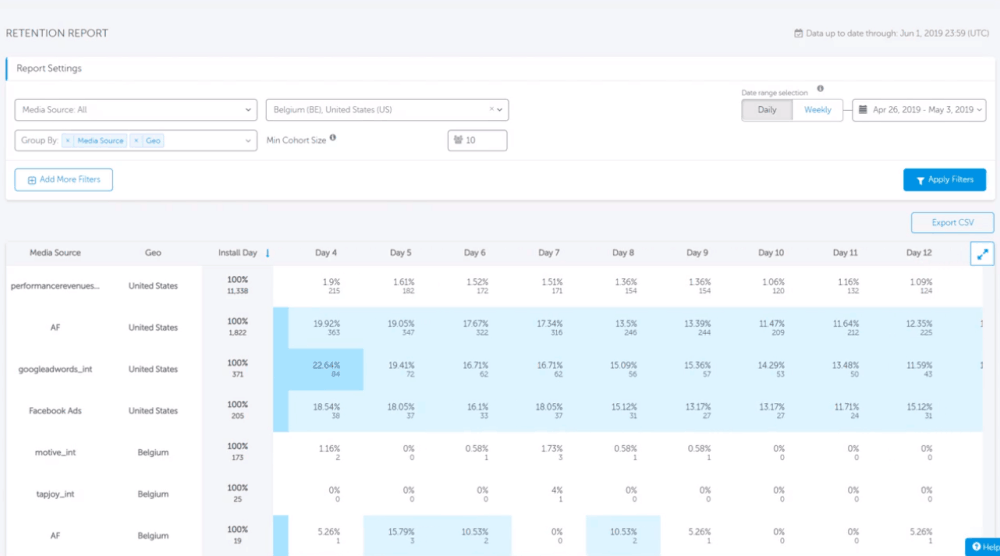
With AppsFlyer, you’ll get useful insights about your marketing performance and user retention. That’s because its powerful cohort and retention reporting tools show you areas where marketing campaigns are doing great and where there’s glaring need for improvement.

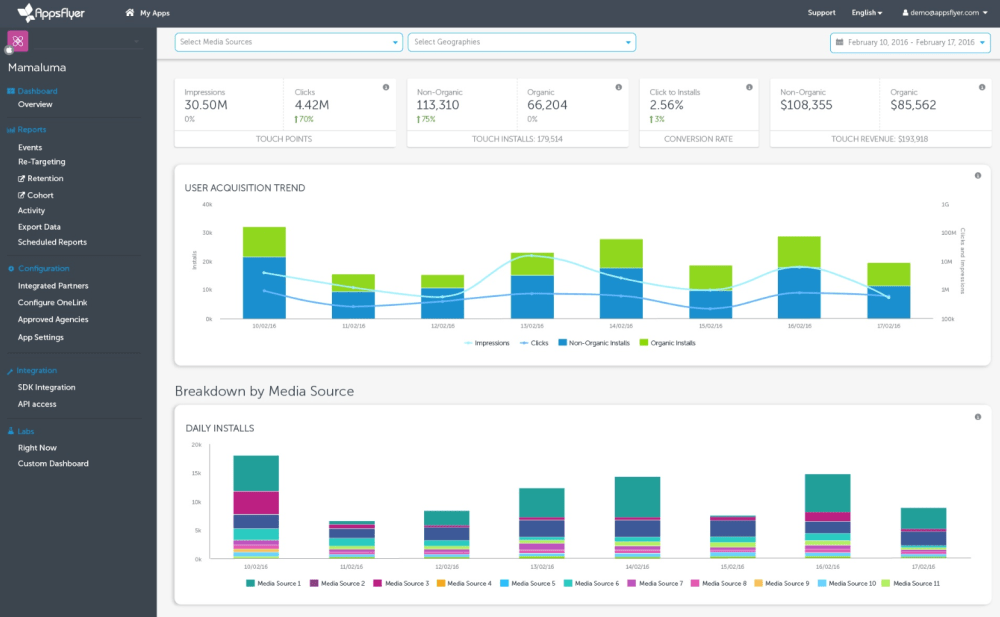
AppsFlyer insights

Additionally, you can customize AppsFlyer’s dashboard with their drag-and-drop interface. This way, you can easily build and view dashboards based on your specific campaigns.

Additionally, the AppsFlyer mobile app enables you to monitor analytics data in real time and share it with your team members. You can also receive live alerts about your key performance indicators (KPIs). Plus, you’ll get other information that’s important for your business.

What’s more, AppsFlyer’s Pivot tool also uses the drag-and-drop interface. This lets you quickly save, edit, clone, and collaborate with your team. Plus, you can do all of this without having to download data or rebuild pivot tables. This way, marketers can better manage and understand complex data. For instance, you can use it for aggregating performance by media source. Or you can run deep campaign analyses.

How Branch Provides Analytics

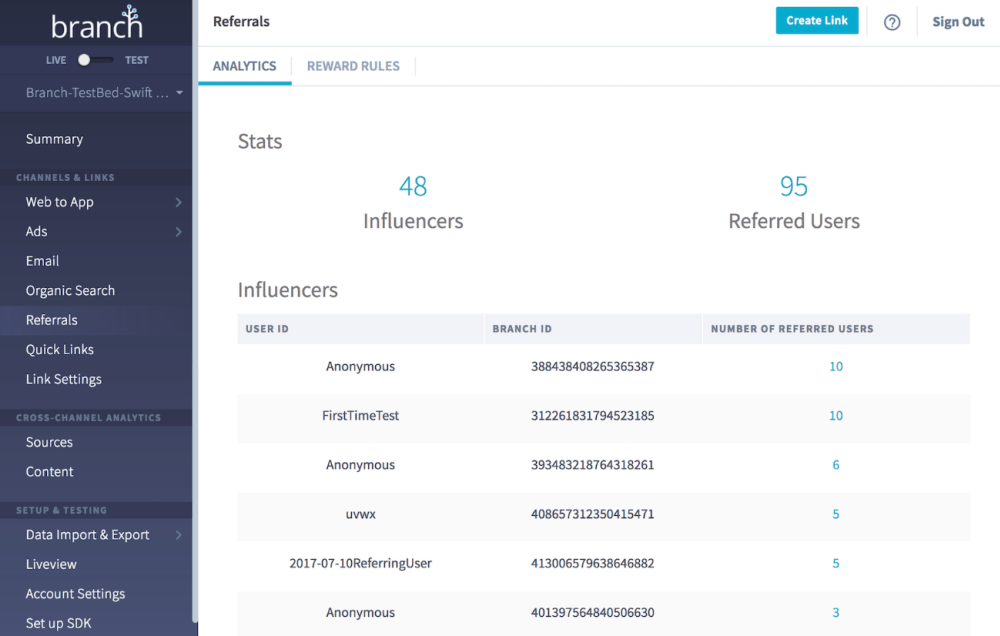
One of the practical-use cases of Branch’s detailed analytics reporting is that it makes it easy to identify top-performing influencer campaigns. For example, when you know which ones are driving the most app downloads, you can deepen your most lucrative relationships. Then you can also forge more of them with similar figures.

Although Branch
does offer a cohort analysis tool to help marketers understand the ROI of their
campaigns, it doesn’t support retention monitoring or reporting.

Branch cohort analysis tool

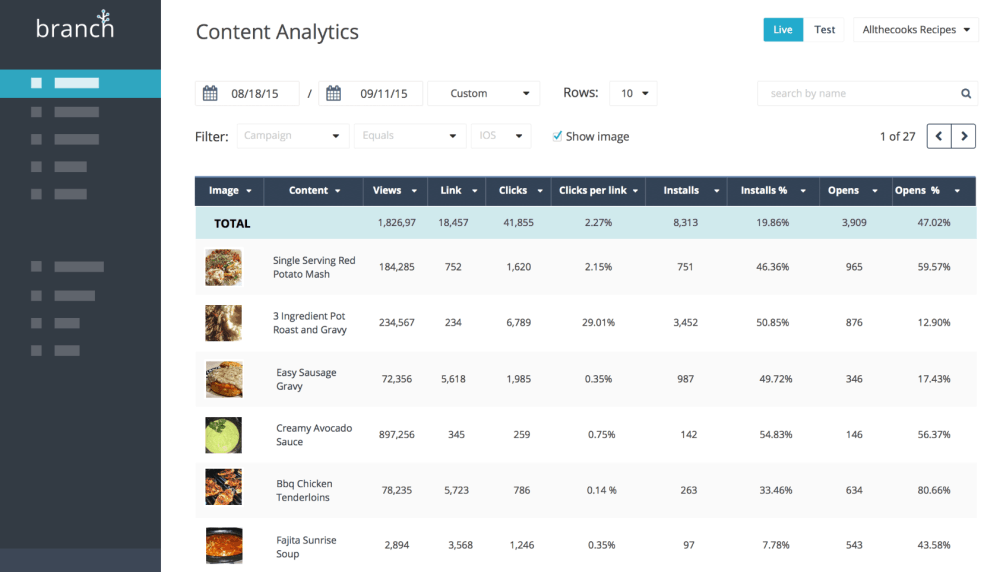
Branch’s Content Analytics section allows you to figure out which content is most successful at driving app installs. This way, you’ll be able to promote that particular content with marketing campaigns or deep linked sharing. With Branch, you can repeat this process to identify new content that drives app downloads.

Additionally, Branch’s Data Feeds feature allows you to import analytics data using several integrations. For instance:

  • Webhooks let you send Branch events to any endpoint you want
  • Data integrations offers a number of analytics and marketing features
  • The query API will help you programmatically query analytics data
  • Data export API will give you access to all of your Branch data

However, unlike AppsFlyer, Branch doesn’t let you create custom dashboards to view specific information sets based on your marketing campaigns.

Factor #3: Integrated Partners

The mobile ecosystem calls for many types of reports that have an effect on acquisition. These could include metrics from the services you use for attribution. Also, they can include product analytics, A/B testing, and marketing automation.

Integrating with third-party platforms provides more value to advertisers. That’s because you can use the insights you glean for optimizing marketing efforts or running retargeting campaigns.

Using AppsFlyer Mobile App Attribution with Integrated Partners

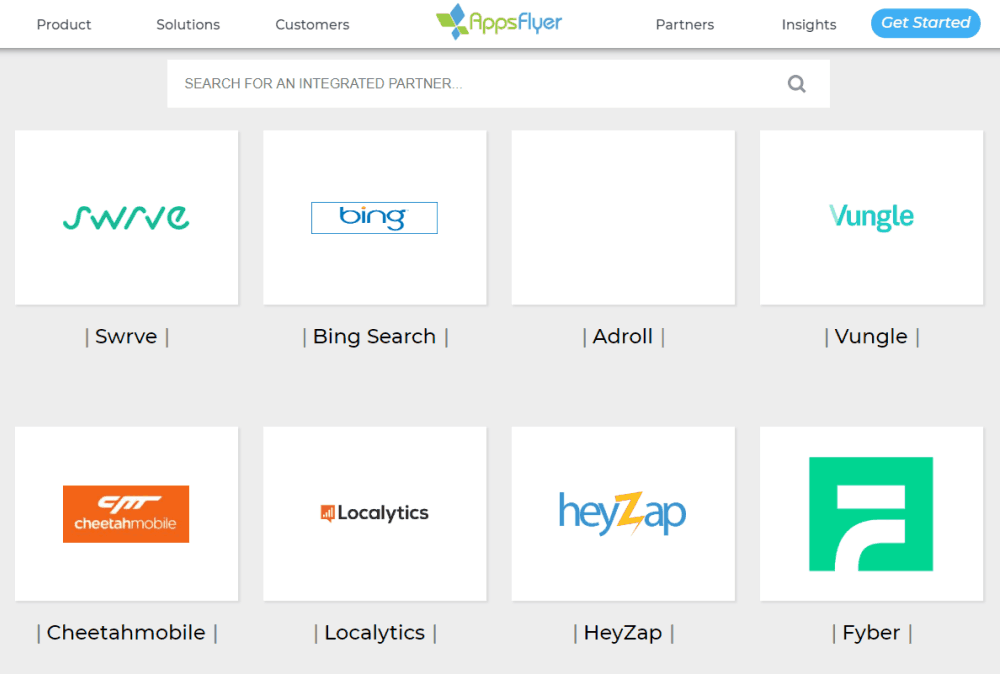
With the AppsFlyer software development kit (SDK) you can experiment with different integrated partners. This lets you identify the ones that give you the best ROI from your marketing campaigns.

AppsFlyer SDK

Here are some of
the different types of integrated partners you can get access to with the
AppsFlyer platform:

Ad Networks

These networks connect advertisers to apps looking to host ads. Ad networks act as consolidations of a large ad space supply from publishers and match it to fulfill advertisers’ demands.

Agency Reports

There are companies that manage marketing campaigns on behalf of advertisers. They might work with all types of apps or focus on a specific area, such as gaming apps.

Analytics Platforms

These are third-party solutions that offer in-app analytics reporting. Interestingly, these integrations can push data back and forth. Therefore, you can perform behavioral analysis based on various segments of your end users.

Affiliate Networks

These networks enable publishers to get a share of the revenue advertisers earn that result from visitors to the publisher’s app. Alternatively, publishers earn a fee for each visitor who performs a specific action.

RELATED ARTICLE: CRITICAL ASPECTS OF BUILDING AN AUTHORITATIVE AFFILIATE SITE

Retargeting Networks

These are ad networks that specialize in retargeting. Retargeting engages users who interacted with an ad but didn’t yet install the app. You can also use these networks for re-engagement. With re-engagement, you give targeted discounts to users who’ve already installed your apps to make them active users. Also, use these networks for re-attribution. These are campaigns targeted at users who’ve uninstalled the app to get them to reinstall it.

Direct Publishers

These are app owners who integrate their apps
directly with AppsFlyer for superior in-app monitoring.

Facebook Marketing Partners/Twitter Official Partners

These are partners who comply with Facebook and Twitter’s criteria and get their approval. For example, this could be a particular technology such as automated posting apps. Or they could be media-buying platforms that allow marketers to book ads on Facebook and Twitter.

Programmatic Advertising

This refers to the ability of an ad network to buy spots for ads from different platforms without involving a third party.

Branch and Integrations

With Branch, you get a number of integrations to make sure your attribution workflow runs smoothly.

Branch integrations

These include:

Universal Ad Partners

With Branch Universal Ads, you’re able to try
out ad networks with unique segmentation algorithms to reach a targeted
audience. This is available as a pre-configured and ready-to-use integration.

Universal Email Partners

These services enable you to seamlessly integrate email marketing campaigns within your workflows. For example, you can use leading email service providers without losing your current analytics.

Data Integration Partners

This integration enables you to use
pre-formatted webhooks to automatically send Branch data to your analytics and
marketing tools.

Factor #4: Data Integrity

When it comes to mobile app attribution, it’s important to make sure you’re keeping customer data secure. Failure to do so can cause serious data breaches. These can cause serious damage to your brand and might even expose you to potential lawsuits or fines from regulators.

AppsFlyer and Data Integrity

AppsFlyer maintains full compliance with industry standards. This means AppsFlyer keeps its data centers secure. Moreover, it enforces strict physical, environmental, and hosting controls.

Additionally, AppsFlyer uses multi-layered controls to protect the data infrastructure. This means it actively monitors the improvement of applications, systems, and processes regularly.

This continuous monitoring lets AppsFlyer keep up with the ever-changing security ecosystem and its challenges.

AppsFlyer controls

This mobile app attribution platform also isolates each customer’s account data from that of other customers. Additionally, it encrypts the data at rest. Also, AppsFlyer’s web servers use strong encryption protocols. These protocols secure the connections between its users’ devices and its own web services and servers.

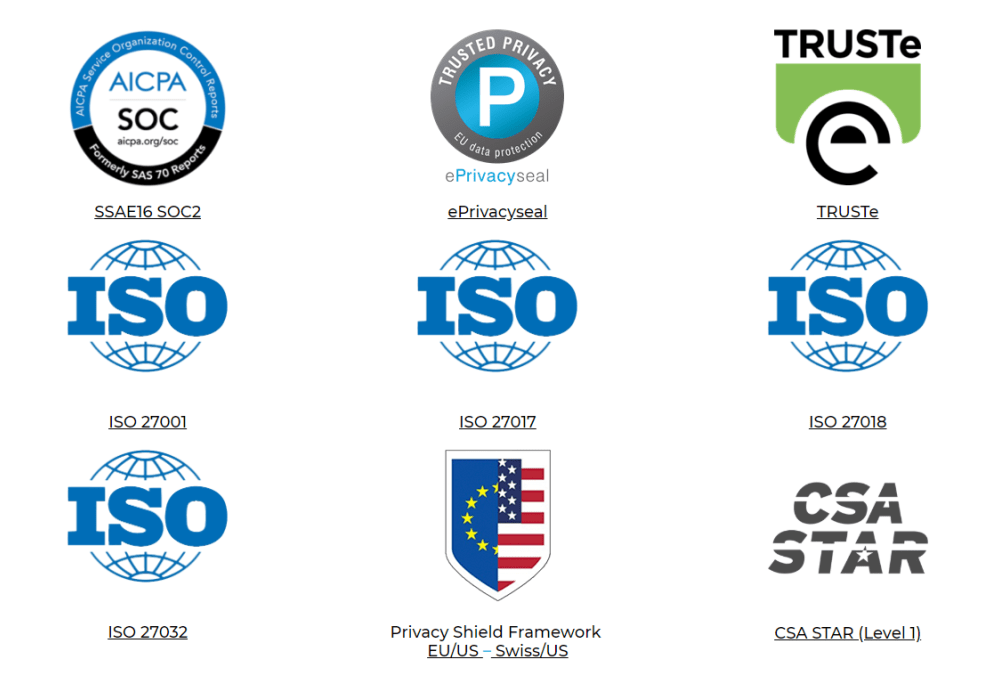
Every change made at AppsFlyer is measured, reviewed, and approved by following a strict process. This process ensures that operational changes meet AppsFlyer’s business goals and compliance guidelines. These include GDPR, TRUSTe, and ePrivacyseal.

Branch and Data Integrity

Branch ensures strict compliance with GDPR to secure the data it holds. This data security directive gives specific guidelines, including the right to object to data processing. However, to submit a GDPR end user request, you’ll have to go through the Branch GDPR portal. Then you must specify the end user’s advertising identifier (for example, IDFA or GAID). Also, you must specify the date when you received their request.

Just keep in mind that even after Branch stops tracking end users, they’ll still be able to generate and share Branch links. In addition, basic deep-linking functionality will also continue to work.

However, end users who object to data processing won’t be able to benefit from seamless customer journeys across multiple platforms. (Branch enables marketers to offer their other end users these seamless journeys.)

Which Mobile App Attribution Platform Is Right for You?

With the right
mobile app attribution platform, you’ll be able to find out how a user first
learns about your app, what drives them to install it, and how they interact
with it. This information can help you optimize your marketing campaigns and
convert more customers.

After reading
this article, between AppsFlyer and Branch, which mobile app attribution
platform are you leaning toward and why?

[ad_2]

Source link

Filed Under: Biz Opportunities

25 Unforgettable Moments in Space Exploration to Celebrate the 50th Anniversary of Apollo 11

July 15, 2019 by Asif Nazeer Leave a Comment

[ad_1]

The moon landing was just the beginning.


July
15, 2019

8 min read


On July 20, 1969, 650 million people watched as Neil Armstrong and Buzz Aldrin became the first humans to walk on the moon. NASA’s lunar landing was years in the making, a feat of engineering and ingenuity taken on by a team of more than 400,000 people to test and build the spacecraft, rockets, suits and instruments on board and to calculate how to get Armstrong, Aldrin and Michael Collins safely there and back — although at the time there was no guarantee that would be the case.

The space race kicked into high gear in April 1961 when Russian cosmonaut Yuri Gagarin became the first human to orbit the Earth. While the Soviet Union’s accomplishment spurred the United States to put a man on the moon before the 1960s came to a close, space exploration has long since become a more internationally collaborative affair.

In the private sector, Virgin Galactic announced that it was going public, making it the first space tourism company to be publicly listed, beating out main competitors Jeff Bezos’s Blue Origin and Elon Musk’s SpaceX.

Related: Buzz Aldrin Wants You to Know — the Sky Is Not the Limit

The company says that it received customer reservations from more than 600 people in 60 countries, who put down $80 million in collected deposits for the chance to head up to space on one of Virgin Galactic’s spacecrafts.

Virgin Galactic’s founder Richard Branson said back in February that he was aiming to take his first suborbital flight on the lunar landing anniversary. While there hasn’t been any official announcements from Branson that he will be making the trip yet, there definitely will be people traveling to space on that special date. 

On July 20, 2019, exactly 50 years to the date of the Apollo 11 launch, cosmonaut Alexander Skvortsov, NASA astronaut Andrew Morgan and European Space Agency astronaut Luca Parmitano, who hails from Italy, will travel to the International Space Station. They’ll join fellow Expedition 60 crew members, NASA astronauts Christina Koch and Nick Hague and cosmonaut Alexey Ovchinin, the current ISS commander.

Read on to glance back on some historic moments and look ahead to what’s on the horizon for space exploration.

Don’t stop me now.

Don't stop me now.

Image credit:

NASA

On March 22, 1946, a rocket called the JPL-Ordnance Wac was the first American rocket to leave earth’s atmosphere.

Here’s looking at you.

Here's looking at you.

Image credit:

US Navy

1946 was a big year for out-of-this-world achievements. On Oct. 24, a V2 rocket launched from the White Sands Missile Range in New Mexico equipped with a 35-millimeter camera and captured the first ever images of earth from space.

The space race begins.

The space race begins.

Image credit:

NASA

On April 12, 1961, the space race was kicked off in earnest when Soviet cosmonaut Yuri Gagarin became the first human ever in Earth’s orbit.

America gets in the game.

America gets in the game.

Image credit:

NASA

On May 5, 1961, astronaut Alan B. Shepard completed the Freedom 7 mission — the United States’ first suborbital flight. In July, Virgil I. “Gus” Grissom, completed the second suborbital mission for NASA.

To put a man on the moon.

To put a man on the moon.

Image credit:

NASA

On May 25, 1961, President John F. Kennedy addressed Congress about the necessity to invest in space exploration, famously saying, “I believe that this nation should commit itself to achieving the goal, before this decade is out, of landing a man on the moon and returning him safely to the earth. No single space project in this period will be more impressive to mankind, or more important for the long-range exploration of space; and none will be so difficult or expensive to accomplish.”


Beaten to the punch.

Beaten to the punch.

Image credit:

NASA

From Jan. 31 to Feb. 3, 1966, an unmanned Soviet spacecraft called Luna 9 made the first successful soft landing on the moon and then sent the first radio television transmission back to earth.

Making an impact.

Making an impact.

Image credit:

NASA

On March 1, 1966, another Soviet ship, the Venera 3, became the first spacecraft to impact the surface of another planet on its mission to Venus.

First contact.

First contact.

Image credit:

NASA

A few months later, on June 2, 1966, Surveyor 1 becomes the first U.S. spacecraft to land on the moon.

Competition is mounting.

Competition is mounting.

Image credit:

NASA

On May 19, 1971, Russian spacecraft Mars 2 became the first to make an impact on Mars, with the first soft landing on the planet following on May 28.

Take a lap.

Take a lap.

Image credit:

NASA

But on Nov. 13, 1971, Mariner 9, an unmanned NASA probe, completed an orbit around Mars and is the first spacecraft to orbit around another planet.

The Red Planet.

The Red Planet.

Image credit:

NASA

A month later, on Dec. 2, 1971, Russia’s Mars 3 completes the first unmanned landing on Mars.

A new frontier.

A new frontier.

Image credit:

NASA

On July 20, 1976, NASA’s Viking 1 was the first successful U.S. mission to land on the surface of Mars. Viking 1 ultimately spent four years and conducted 1,489 orbits of the planet, while Viking 2, which arrived on Sept. 3, 1976, worked until July of 1978. Both transmitted images and studied the terrain of the planet, searching for possible life and sending back valuable information to NASA, laying the groundwork for the Curiosity Mars Rover’s memorable arrival in 2012.

A tragic day.

A tragic day.

Image credit:

NASA

On Jan, 28, 1986, the Challenger Space Shuttle explosion saw the terrible loss of the seven crew members on board.

Step right up.

Step right up.

Image credit:

NASA

The first-ever commercial space tourist, an American millionaire and businessman from New York named Dennis Tito, hitched a ride up to the International Space Station on the Russian Soyuz-TM 32 on April 28, 2001.

A new member of the team.

A new member of the team.

Image credit:

NASA

On Feb. 24, 2011, the International Space Station got a cool new helper in the form of Robonaut 2, the first ever humanoid robot in space.

A sweet ride.

A sweet ride.

Image credit:

Virgin Galactic

In February 2016, Richard Branson unveiled Virgin Galactic’s second SpaceShipTwo spacecraft — the first company spacecraft to be manufactured wholly in-house. It is called the VSS Unity.

Sticking the landing.

Sticking the landing.

Image credit:

SpaceX

On April 8, 2016, Elon Musk’s 14-year-old SpaceX’s Falcon 9 rocket made its first ever landing at sea after successfully delivering cargo to the ISS.

Third time’s a charm.

Third time’s a charm.

Image credit:

Blue Origin

In April 2017, Amazon founder Jeff Bezos’ spaceflight startup Blue Origin launched and landed its reusable rocket for the third time. 

Are we alone in the universe?

Are we alone in the universe?

Image credit:

NASA

On April 13, 2017, scientists at NASA shared findings from the agency’s Cassini spacecraft mission to Saturn. It seems that a chemical reaction that is occurring underneath the icy surface of one of the planet’s moons, Enceladus, could be a sign that it could also support alien life, in another potentially groundbreaking discovery in the search for life beyond Earth. On September 15, 2017, Cassini ended its 20 year mission. 


New worlds to explore.

New worlds to explore.

Image credit:

NASA

On Feb. 22, 2017, NASA announced the discovery of a planetary system of seven Earth-sized planets orbiting around a red dwarf star. It was named TRAPPIST-1 and it is the first system that NASA has found like it. Three of the planets in the system are in what’s called the habitable zone, which means that there is a possibility that the worlds are home to liquid water and a life-supporting atmosphere.


Breaking records and glass ceilings.

Breaking records and glass ceilings.

Image credit:

Amanda Edwards | Getty Images

In June 2018, Peggy Whitson, the first female commander of the International Space Station and first woman to be chief of NASA’s astronaut corps, retired after 32 years with NASA. Whitson completed three missions on board the ISS — two of which she led — and spent 665 total days in space, which is more than any other NASA astronaut. 

Whitson also conducted more spacewalks than any other female astronaut, spending 60 hours and 21 minutes outside of the space station. On her last space station mission, Whitson became the oldest female astronaut, at 57, to reach orbit.

In February 2020, Astronaut Christina Koch will return to Earth after an 11-month stay onboard the ISS, nearing Kelly’s 340 days in orbit. In December 2019, she will pass Whitson’s 288 days in space, setting a new record for female astronauts.

The secrets of Mars.

The secrets of Mars.

Image credit:

AL SEIB | Getty Images

On Nov. 26, 2018, NASA successfully landed the InSight Mars lander on the red planet in order to better understand the inner workings of Mars. NASA will use the probe to take the planet’s “vital signs,” closely monitoring weather, temperature, tectonic activity — meaning Marsquakes — and what happens when meteorites hit the planet. It took the probe six months to travel more than 300 million miles, and was the first landing on Mars since the Curiosity Rover in 2012. 

Farewell Kepler, Hello TESS.

Farewell Kepler, Hello TESS.

Image credit:

Orlando Sentinel | Getty Images

On Oct. 30, 2018, NASA’s Kepler space telescope was retired, and the nine-year-long planet hunting mission came to an end. The Kepler team discovered 2,899 exoplanet candidates and confirmed the existence of 2,681 exoplanets in the galaxy outside of our solar system.

But while Kepler said goodbye, in April of 2018, NASA launched TESS — short for Transiting Exoplanet Survey Satellite — into orbit for a two-year mission to see which exoplanets could harbor and support life.

Going farther than ever before.

Going farther than ever before.

Image credit:

NASA | Getty Images

On Jan. 1, 2019, NASA’s New Horizon spacecraft completed the furthest flyby ever, capturing images of a 20-mile wide minor planet classified as 2014 MU69. Its nickname is Ultima Thule, which translates to “distant places beyond the known world.” New Horizons was also the first spacecraft to fly past Pluto in 2015.

Humans living in space?

Humans living in space?

Image credit:

NBC NewsWire | Getty Images

On April 12, 2019, the results of NASA’s Twin Study was published in the academic journal Science. The paper detailed the findings of the research, which monitored the effect of spaceflight on the human body. The study’s test subjects were twin brothers and retired NASA astronauts Scott and Mark Kelly.

Scott Kelly spent 340 days in space on the International Space Station and became the first American astronaut to spend almost a year in space. He returned to earth on March 2, 2016. The research revealed the ways spending that much time in space can affect things such as the expression of genes and immune system responses.

“Our space agencies won’t be able to push out farther into space, to a destination like Mars, until we can learn more about how to strengthen the weakest links in the chain that make space flight possible: the human body and mind,” wrote Kelly in his memoir, Endurance: A Year in Space, A Lifetime of Discovery.

[ad_2]

Source link

Filed Under: Entrepreneur

Project Staffing on a Budget: 14 Critical Things to Remember

July 14, 2019 by Asif Nazeer Leave a Comment

[ad_1]

14 Critical Things to Remember When Project Staffing On a Tight Budget
Think about project staffing on a tight budget. Many businesses find it a difficult task. Businesses need to be able to find the right balance. When assigning staff or budget to a project, ensure that the company makes the best use of people’s skills. And makes the best use of company resources too. Look at the scope of the project. Establish a time frame. Provide a good starting point for planning and scheduling. But think about other considerations to keep in mind too. Find out more. We asked members of the Young Entrepreneur Council (YEC) the following:

“What is an important thing to remember when figuring out how many people need to work on a project, especially when resources — including time, money, or the number of people available — are tight?”

Project Staffing on a Tight Budget

Consider what YEC community members say about project staffing on a tight budget:

1. Phase In Your Staff as Needed

“Many projects go through phases that require different skill sets at different times. For instance, if you’re launching a new product you’ll have engineers, designers, and product managers involved heavily early on, but as the product becomes finalized and goes to market, you can then phase out most of the engineers and bring in more marketers and salespeople to push the product.” ~ Andy Karuza, FenSens

2. Select a Project Leader

“When creating small groups for a project, take someone who has a lot of experience with past similar projects. Take them aside and ask them how many people they think they’ll need to complete the project in a timely manner. If you’re tight on resources, explain that to them and find out the essentials needed to complete the project on time.” ~ Andrew Saladino, Kitchen Cabinet Kings

3. Look for Team Members With Strong Problem-Solving Skills

“One characteristic that is highly valued in our company is the capacity our team members have to solve different problems in less time. When the time comes to make teams, we allocate the ones who are ready to handle any difficulty as project leaders.” ~ Alfredo Atanacio, Uassist.ME

4. Make Sure Staff Are Reliable and Time-Conscious

“When resources are tight, you’d need your best people forward. Staff who have the skills, experience and excellent work history to show for it are more coachable, time-conscious, and have the wealth of knowledge that’s critical for weeding out strategies that don’t work. If you can’t afford to do trial and error, then you need people who don’t have to.” ~ Diego Orjuela, Cables & Sensors

5. Watch for Scheduling Issues

“Consider the other projects that are going on at the same time. If the latest project needs a certain team member but they are wrapped up in something else, this can present issues. Plan the project for a time when that team member is able to give their full attention.” ~ Stephanie Wells, Formidable Forms

6. Create a Budget Beforehand

“If you want to see how many employees you can have on one project, create a budget. This will show you how much money and resources you’re working with so you can have the right amount of people working on it, while knowing that they’ll get the job done effectively. If you don’t have the budget to do a good job, it’s best to move on to something else.” ~ Chris Christoff, MonsterInsights

7. Seek Employees’ Input

“Before deciding on a group for a project, ask your employees for their input. For instance, maybe you’ve already chosen a project leader so you can ask them which team members would work well on the team, how much time they think the project will take, and so on. Getting a second opinion will give you a better idea for how to build a project team that works.” ~ John Turner, SeedProd LLC

8. Gauge Their Expertise and Responsibilities

“You need to properly gauge your team members’ individual levels of expertise and how much responsibility they have when calculating how many people to put on a project. This is how you’ll determine what each person can handle and what level suits their expertise so you aren’t wasting resources, money or time.” ~ Jared Atchison, WPForms

9. Balance the Urgency of Each Project

“It is very important to know the strengths and weaknesses of your team to properly allocate them to certain tasks. Efficiency is number one when it comes to running a profitable company. In order to attain maximum efficiency, you need to balance the urgency of each project that you are working on based on due date, potential profit, and current schedule.” ~ David Chen, Sharebert

10. Ask About the Need for Ancillary Help

“You shouldn’t just guess. Make sure the people with the top skills needed to complete the project are assigned to it and add in extra ancillary help if necessary. Consult with your top folks to see how many “extras” are needed. If the answer is “none,” go with it. They’re not going to tell you that more are needed if they aren’t, and they’re not going to say that extra help isn’t needed if it is.” ~ Andrew Schrage, Money Crashers Personal Finance

11. Empower Mid-Level Managers to Make Assessments

“Delegate and empower the mid-level managers to make these decisions and organize support, then manage your managers through timelines and metrics critical to project success. Upper-level managers are further removed from the day-to-day operations and their “estimate” is likely to be less accurate than a mid-level manager who understands what goes where and how. Trust your team and your structure.” ~ Matthew Capala, Alphametic

12. Establish Accurate Time Estimates

“Accurate time estimation allows you to know how long tasks will take and the number of people you will need to complete the work. Project managers should identify all tasks that need to be completed, as well as time that will be spent on meetings, communications, tests and reports. Without doing this first, time will get wasted and projects won’t get completed on time or within budget.” ~ Blair Thomas, eMerchantBroker

13. Have Teams Self-Report

“Have your teams estimate their own resourcing needs. And build in a system where they report back to themselves and the broader team on their progress. By doing this you create more buy-in from your staff. Because they tell you how long or costly something will be. In turn, this makes them more accountable. And excited to celebrate the win of hitting the goals they set for themselves.” ~ Tony Scherba, Yeti

14. Remember: More People Doesn’t Always Mean Faster

“When staffing a project, always remember that having more people assigned to it does not always mean it will go faster. When our clients ask to have more developers put on their software project, we often use the analogy of painters painting a room. If you have a small room, shoving 10 painters in there instead of two won’t make it go any faster; rather, it’ll likely slow it down.” ~ Keith Shields, Designli

Image: Depositphotos.com

This article, “Project Staffing on a Budget: 14 Critical Things to Remember” was first published on Small Business Trends


[ad_2]

Source link

Filed Under: Strategy

These Seminars will Teach You About Apps to Transform Your Business

July 13, 2019 by Asif Nazeer Leave a Comment

[ad_1]

When you get an app for your small business, it has to work with what you already have. Any compatibility issues and the inefficiencies it creates will result in additional pain points until it is fixed.

Zoho has more than 40 apps for small businesses which work together seamlessly. In addition to providing all of these solutions, the company holds free seminars designed to teach users the ins and outs of its apps.

Finance Seminar ’19 is going to be held in four cities across the U.S. in the month of July. The first of which will be in New York City on July 16 and 17, 2019. The NYC seminar will be followed by Miami (July 18), Houston (July 19), and Los Angeles (July 25).

The seminar is going to teach you how to improve your business with Zoho’s cloud-based finance platform. The Zoho product team will be on hand to answer all of your question one-on-one.

At the end of the seminar, you will run your back-office operations, and optimize your workflows to run your business more efficiently.


The seminar is free, so click the red button and register.

Register Now


Featured Events, Contests and Awards

Free Seminar: Basics and Best Practices for Streamlining Business Finances (NYC, NY)Free Seminar: Basics and Best Practices for Streamlining Business Finances (NYC, NY)
July 16, 2019, New York, NY

Join this free finance seminar to dive deep into accounting for small business owners, bookkeepers and CPAs. You’ll learn all about Zoho apps and how you can manage everything from invoicing and expense policies to analytics, approval workflows, and more with a single suite. Register today, it’s free!


Listening to the Voice of the Customer Listening to the Voice of the Customer
October 16, 2019, Chicago, Ill.

Led by veteran product development and market research experts, this course will introduce Voice of the Customer (VOC) market research and teach you to use it to accelerate innovation in business-to-business markets. The workshop uses a lively, interactive format with numerous hands-on activities and practice exercises to build skills and will also expose you to the latest applications of these techniques in areas such as machine learning and journey mapping.
Discount Code
SMALLBIZ ($100 Off)


More Events

  • SkySprout Summit – Columbus Marketing Conference
    July 16, 2019, Columbus, Ohio
  • Free Seminar: Basics and Best Practices for Streamlining Business Finances (Miami, FL)
    July 18, 2019, Miami, Fla.
  • Free Seminar: Basics and Best Practices for Streamlining Business Finances (Houston, TX)
    July 19, 2019, Houston, Texas
  • Free Seminar: Basics and Best Practices for Streamlining Business Finances (Los Angeles, CA)
    July 25, 2019, Los Angeles, Calif.
  • Developing an HR Strategy (Seminar)
    August 14, 2019, San Francisco, Calif.
  • Funding a Business Course – Application Deadline
    August 23, 2019, Oakland, Calif.
  • World Blockchain Roadshow
    August 26, 2019, Multiple Cities
  • TECHSPO Sydney 2019
    August 28, 2019, Sydney, Australia
  • DigiMarCon Europe 2019 – Digital Marketing Conference & Exhibition
    September 12, 2019, Amsterdam, the Netherlands
  • DigiMarCon Asia Pacific 2019 – Digital Marketing Conference & Exhibition
    September 18, 2019, Singapore
  • World’s Largest MBA Tour is Coming to Philadelphia – Register for FREE
    September 30, 2019, Philadelphia, Pa.
  • DigiMarCon Singapore 2019 – Digital Marketing Conference & Exhibition
    October 02, 2019, Singapore
  • World’s Largest MBA Tour is Coming to Miami – Register for FREE
    October 16, 2019, Miami, Fla.
  • World’s Largest MBA Tour is Coming to Austin – Register for FREE
    October 21, 2019, Austin, Texas
  • TECHSPO Dubai 2019
    October 22, 2019, Dubai, United Arab Emirates
  • Rhodium Weekend
    October 24, 2019, Las Vegas, Nev.
  • World’s Largest MBA Tour is Coming to Denver – Register for FREE
    October 28, 2019, Denver, Colo.
  • Small Business Expo 2019 – LOS ANGELES (October 30, 2019)
    October 30, 2019, Los Angeles, Calif.
  • IMPACT>MOBILITY USA 2019
    November 04, 2019, San Diego, Calif.
  • National Small Business Week
    May 03, 2020, Online

More Contests

This weekly listing of small business events, contests and awards is provided as a community service by Small Business Trends.

You can see a full list of events, contest and award listings or post your own events by visiting the Small Business Events Calendar.

Image: Zoho

This article, “These Seminars will Teach You About Apps to Transform Your Business” was first published on Small Business Trends


[ad_2]

Source link

Filed Under: Strategy

In the News: Business Owners and Clients Increasingly OK with Texting After Hours

July 12, 2019 by Asif Nazeer Leave a Comment

[ad_1]

We’re always working anymore.

We may post business hours on our office or stores but those don’t tell how much business owners are working before and after them. But maybe that’s because our customers are OK with it?

That’s why we weren’t too surprised by the results of a new survey from Carphonewarehouse this week. They found that 73% of business owners think it’s OK to text clients after business hours.

If that many believe it’s OK to text a business client after business hours, that must mean they’re not getting a lot of push back from those clients they’re texting.

Now, this could be a good and a bad thing. Yes, keeping clients happy is great. But you’ll need to establish boundaries if you’re available outside your listed business hours. Otherwise, you’ll never get away from work.

For the rest of the week in small business news, check out our roundup below:

Finance

New Mastercard Partnership Helps Gig Workers Get Paid

Digital technology is providing more options for today’s workforce. And workers are using these options for greater autonomy and independence. But this independence brings with it challenges when it comes to finances and reliable income.

Sales

4 Tips About Customer Refunds You Need to Know

Good news — you received a payment from a customer or client. The bad news is, they’re now asking for a refund. Refunding requests can be disheartening, but they can happen from time to time. Don’t go into a panic or ignore the request when you get one.

Small Business Operations

Attention: 13 Small Business Documents You Must Keep on Hard Copy

A business entity exists under its documentation. Without the proper records, registration, licenses and other legal documents, a company is just an idea in the owner’s head. Having hard copy business documents registered in the right places make the business a real entity.

Social Media

What You Need to Know About Facebook Places for Your Business

Facebook Places is a geolocation tool that is designed to help users share their favorite spots and discover new ones. Users can “check in” at various locations, from cities to movie theaters to small boutiques, and then share updates with their connections that include a map and pin showing that exact location.

Startup

FreshBooks New Feature Helps Businesses Set Up Retainer and Recurring Payments

One of the biggest challenges for small business owners is eliminating the labor-intensive processes of daily operations. And one of these operations is the many tasks in accounting. A new feature from FreshBooks is going to help businesses by setting up a retainer and recurring payments from clients.

Taxes

65% of Small Businesses Got a Tax Refund for 2018 – and Most Were Happy

For individual taxpayers, refunds are a common thing. But for small businesses, it depends on the type of entity you establish and the type of taxes you pay. 2018 Small Business Tax Refunds Survey According to a report from OnDeck, 65% of the business owners received a tax refund in 2018. And while 75% said they were satisfied with the outcome, 1 in 4 weren’t.

Technology Trends

Canva Flyer Maker Provides Small Businesses with a New Marketing Tool

Canva’s Flyer Maker lets you create professional flyers in seconds. It’s a web based tool giving small business owners graphic design capabilities. Small Business Trends contacted Liz McKenzie, Head of PR and Communications at the company, to learn more. Canva Flyer Maker Why It Matters Canva’s Flyer Maker was designed for the busy small business owner.

Image: DepositPhotos.com

This article, “In the News: Business Owners and Clients Increasingly OK with Texting After Hours” was first published on Small Business Trends


[ad_2]

Source link

Filed Under: Strategy

  • « Previous Page
  • 1
  • …
  • 85
  • 86
  • 87
  • 88
  • 89
  • …
  • 172
  • Next Page »

Sign up for our newsletter and receive a free EBook on how to boost productivity


Find it

Blog By

Small Business Consultant and Accountant helping grow your small business Read More…

Follow us online

  • Email
  • LinkedIn
  • Twitter

Recent Posts

Unlock Small Business Triumph: Your Definitive Guide to Success

Small Business Topics: A Comprehensive Guide for Success As a … [Read More...]

  • Why the F&B Sector Needs Streamlined Payment Methods – Business
  • The Rise of AI in Ecommerce Outsourcing – Ecommerce
  • The Benefits of Turnkey Tech Solutions for Forex Brokers – Business

Archives

  • December 2024 (1)
  • March 2024 (2)
  • February 2024 (3)
  • January 2024 (1)
  • December 2023 (3)
  • November 2023 (1)
  • October 2023 (3)
  • September 2023 (6)
  • August 2023 (1)
  • July 2023 (5)
  • June 2023 (16)
  • May 2023 (1)
  • April 2023 (2)
  • March 2023 (4)
  • February 2023 (2)
  • January 2023 (5)
  • December 2022 (5)
  • November 2022 (8)
  • October 2022 (7)
  • September 2022 (6)
  • August 2022 (6)
  • July 2022 (13)
  • June 2022 (11)
  • May 2022 (7)
  • April 2022 (8)
  • March 2022 (12)
  • February 2022 (8)
  • January 2022 (11)
  • December 2021 (9)
  • November 2021 (10)
  • October 2021 (11)
  • September 2021 (3)
  • August 2021 (10)
  • July 2021 (12)
  • June 2021 (5)
  • May 2021 (10)
  • April 2021 (17)
  • March 2021 (40)
  • February 2021 (39)
  • January 2021 (58)
  • December 2020 (66)
  • November 2020 (59)
  • October 2020 (34)
  • September 2020 (47)
  • August 2020 (37)
  • July 2020 (2)
  • May 2020 (1)
  • April 2020 (1)
  • March 2020 (33)
  • February 2020 (25)
  • January 2020 (20)
  • December 2019 (27)
  • November 2019 (28)
  • October 2019 (34)
  • September 2019 (38)
  • August 2019 (13)
  • July 2019 (44)
  • June 2019 (40)
  • May 2019 (58)
  • April 2019 (51)
  • March 2019 (43)
  • February 2019 (44)
  • January 2019 (43)
  • December 2018 (47)
  • November 2018 (43)
  • October 2018 (58)
  • September 2018 (44)
  • August 2018 (60)
  • July 2018 (49)
  • June 2018 (58)
  • May 2018 (54)
  • April 2018 (39)
  • March 2018 (46)
  • February 2018 (48)

Topics Covered

business consulting business growth business management business marketing business strategy business topics small business small business success small business topics

Biz Opps

[ad_1] Featured image by Blake Wisz on … [Read More...]

[ad_1] Are you looking for the best ways … [Read More...]

[ad_1] Featured image by … [Read More...]

Customer Focus

[ad_1] First published in Exchange, the magazine … [Read More...]

Entrepreneurs

[ad_1] Uptown Cheapskate is a resale … [Read More...]

[ad_1] A team of neuroscientists in the … [Read More...]

[ad_1] This article was translated … [Read More...]

Strategy

[ad_1] If you buy something through our links, we … [Read More...]

[ad_1] In helping celebrate Black History Month, … [Read More...]

[ad_1] ZOHO started its current Email Marketing … [Read More...]

Supply Chain

[ad_1] Although managing inbound shipping can be … [Read More...]

© Copyright 2015 iSmall-Business.net · All Rights Reserved · Powered by ISmall-Business.net · Admin