ISmall-Business.net

Intelligent Business Solutions

  • Home
  • Strategy
    • Small Business Strategy
      • Combining Niches to Maximize Profit Potential
      • High Ticket Versus Volume Niche Selection
      • How to Know When to Cut a Business or Niche Loose
      • Never Put All Your Eggs in One Basket
    • Sales Strategy
      • Facebook Networking Versus Paid Advertising
      • Brainstorming a Successful Sales Funnel
      • Best Practices for Profitable List Building
      • Backend Sales Strategy Tips
      • A Better Way to Use Webinars for Profits
      • Creating a Welcome Email That Makes Money
    • Production Strategy
    • Human resource strategy
  • Management
    • Business action plan
      • 7 Things to Send JVs to Get Them Onboard
      • Don’t Make JV Promises You Can’t Keep
      • How to Host a Challenge and Maximize Profits
    • Small Business Management
      • Putting Profit Tasks First During Time Management
      • How Self Doubt Sabotages Your Financial Success
      • Repurpose Your Content to Save and Make Money
    • Business Management Topics
      • Fighting the Stigma of Failure
      • Figuring Out the Perfect Launch Date and Time
      • Bonus Creation That Catapults You to Leaderboard Domination
      • Do Customers Prefer Video or Text Courses
      • Minimize Your Risk of Refunds with These 5 Tips
      • How Often Should You Email Promo Material
      • Narrow Niche Domination
      • Perfecting the Launch Process for Increased Profits
    • Business Management Blogs
      • Nobody Expects a Perfect Expert
  • Ideas
    • Find business ideas
      • 5 Lucrative Non IM Niches
      • 6 Niches That Are Hot on Social Networks
      • Are PLR Stores a Viable Way to Make Money
      • How to Know If a Membership Site Is Right for You
    • Idea feasibility
      • How to Make Money Off a $7 Product
      • Recurring Income Options
    • 10 top business ideas
      • Could Coaching Bring in More Money Than Products
      • Individual Coaching Versus Group Coaching Profits
      • Building a Reputation as a Powerful Affiliate
      • Pinterest Profit Niches
    • Low cost business ideas
      • Making Money Off eBooks and Reports
  • Valuation
    • Business Valuation
    • Increase business valuation
      • Making Wise Investments in Tools to Further Your Business
    • Business Valuation Methods
    • Understand business valuation
  • About
    • About Me
    • Blog
    • Contact Us
    • Sitemap
    • Privacy Policy
  • Strategy
  • Supply Chain
  • Customer Focus
  • Entrepreneur
  • Biz Opportunities
You are here: Home / Archives for Asif Nazeer

Netflix, YouTube, Prime Video and Hulu Dominate Streaming, for Now

July 12, 2019 by Asif Nazeer Leave a Comment

[ad_1]

The big four streaming apps make up the majority over over-the-top (OTT) viewing right now, but that may change.


July
12, 2019

2 min read


This story originally appeared on PCMag

In the past few months, everything Netflix has spent billions preparing for has begun to come to pass.

Preceding a new wave of video streaming competition from heavy hitters including Apple, AT&T, Comcast, and Disney, all launching in the next year, Netflix announced it’s losing its two most popular shows. Friends will depart for HBO Max in 2020, and The Office is heading to NBCUniversal’s service in 2021.

According to a recent comScore report, 64 million US households used over-the-top (OTT) streaming services in March 2019, through a smart TV, media streaming device, game console, and other means. The report found that Netflix reaches 75 percent of those households, followed by YouTube at 55 percent.

Amazon Prime Video and the now fully Disney-controlled Hulu reach 44 and 32 percent of those OTT households, respectively. The big four comprise 79 percent of total viewing hours, according to comScore. But for Netflix in particular, the big question is whether its continued investment in originals can replace the engagement it gets from licensed sitcoms.

Nielsen provided PCMag with data from its 2018 SVOD Content Ratings report showing that The Office was the number one Netflix show by hours viewed by a healthy margin last year — more than 52 million hours for its 200-plus episode run. Friends and its 254 episodes were second at over 32 million hours, and the rest of the top five were also licensed shows (Grey’s Anatomy, NCIS, and Criminal Minds), not originals.

Part of the reason for that is syndicated shows simply have more episodes, but the data shows why Netflix has gone into more debt to bankroll billions of dollars in original content spending that often prioritizes quantity over quality. Netflix needs to own more content to keep users subscribed and streaming as more licensing deals expire and well-funded competitors enter the market.

For a deeper dive into the escalating original content war between all of these streaming giants, and where this increasingly cordoned-off landscape leaves consumers, check out our story on the streaming-industrial complex.

[ad_2]

Source link

Filed Under: Entrepreneur

2 Not-so-Secret Secrets for Business Growth

July 11, 2019 by Asif Nazeer Leave a Comment

[ad_1]

Sponsored Post

2 Not-so-Secret Secrets for Business Growth

So you want to grow your company. Business is good — but not good enough. You have bigger dreams.

You want double-digit sales growth. Maybe you want to expand to a new market or launch a new product.

Well, you can’t just snap your fingers and make it happen. It takes hard work.

What if I told you there was a not-so-secret formula to open up growth beyond current projections?

The reality is, we all have growth potential. It’s right there in front of us. It just takes the right moves.

I have two suggestions every business can use if they choose to.

Check out my article over at The Growth Center. I’ve partnered with Microsoft 365 to share my experiences.

Read: 2 untapped technologies for business growth.

Image: Depositphotos.com

This article, “2 Not-so-Secret Secrets for Business Growth” was first published on Small Business Trends


[ad_2]

Source link

Filed Under: Strategy

Phone Safety on Planes? Passengers Don’t Care.

July 11, 2019 by Asif Nazeer Leave a Comment

[ad_1]

A new survey shows exactly what passengers think of cell phone rules set by the FCC and enforced by flight attendants.


July
11, 2019

3 min read


This story originally appeared on PCMag

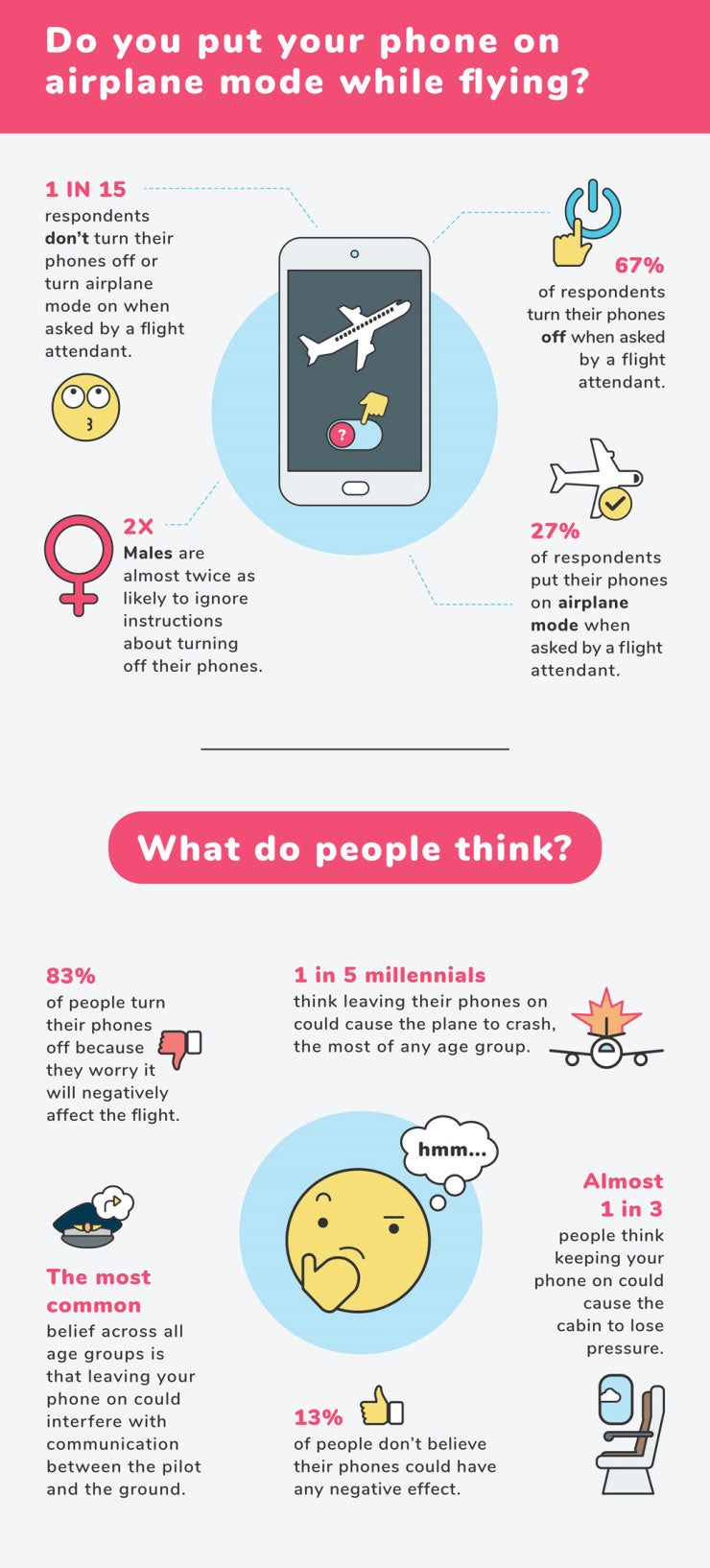
Ever been on a plane as it’s about to take off, with your phone in airplane mode or even turned off, then looked over to see someone FaceTiming at full volume? It happens plenty, despite requests from flight attendants who ask you to turn off connectivity on your phone for your safety (and because the Federal Aviation Administration makes them).

A new survey by AT&T reseller All Home Connections put 1,000 travelers to the test, asking them point-blank what they do with their phones on a plane. The answers might be startling to anyone with aviophobia. They might also seem worth a big ol’ shrug to weary travelers who’ve seen it all and believe the rules are arbitrary, capricious, and a trifle unfair, especially because air travel has become such a chore, with all the pleasure of taking a covered wagon across the prairie in the 1800s.

What it boils down to is this: One in 15 people surveyed never even bother to put their smartphones in airplane mode when a flight attendant asks. Only 67 percent turn off their phones. And men are twice as likely to flaunt instructions from the crew. You can see all the details in this infographic.

All Home Connections went the extra mile and talked to a pilot and author who said pretty clearly that phones “can and do interfere with radio transmissions,” and the only thing saving the plane’s communications with the tower is that the majority of passengers do use airplane mode when requested. It turns out that at least 61.4 percent of respondents believe that to be true. (14.5 percent believe using a phone will outright cause a plan to crash. But considering how many people apparently don’t turn off their phones, the ground would be littered with fuselages and wings if that were the case.)

The survey also covered the worst habits of people on planes. Playing audio without headphones topped the list of things respondents hate, with 83 percent of people annoyed (at best). Fewer people (63 percent) dislike when passengers talk on the phone when the plane is still on the ground. And a lot of people hate when you use a bright screen (whether on a phone or tablet or laptop) when the lights are out for a night flight. Plenty of people would like to see transgressors’ devices confiscated or see them get fined for their hubris. One to 2 percent would like to see them banned, depending on the etiquette “infraction.”

For more, read the full report. Think about it next time you’re flying the not-so-friendly skies.

[ad_2]

Source link

Filed Under: Entrepreneur

Jay-Z Gets Into the Pot Game

July 10, 2019 by Asif Nazeer Leave a Comment

[ad_1]

The legendary rapper/entrepreneur got 99 problems but a bud ain’t one.


[ad_2]

Source link

Filed Under: Entrepreneur

Is Your Business Idea Any Good? 5 Indicators That It Isn’t …

July 9, 2019 by Asif Nazeer Leave a Comment

[ad_1]

Remember fidget spinners? Be careful not to build your business around a fad — and four other important tips.


July
9, 2019

8 min read

Opinions expressed by Entrepreneur contributors are their own.


Given your entrepreneur’s spirit, you likely have more business ideas than you have time to pursue. Every new consumer pain, every new piece of technology, every up-and-coming sales trend: They all seem to spark a new, ambitious, seemingly fool-proof business idea.

Related: How to Come Up With Startup Business Ideas in the Digital Era

And while you’d love to pursue all of those ideas at once, face it: You don’t have the time (and your energy, anyways, is more effectively spent on a single business venture).

So, amidst that raging sea of different business ideas, how can you determine which one is worth pursuing… and which ones are bound to fail? Well, there are always exceptions to the rule, of course, but here are five pretty strong indicators that a business idea isn’t all that great. 

1. No demand exists for the product or service.

No matter how cool, edgy, or compelling you think your idea is, if there’s no existing demand for the pain that that business will solve or the pleasure it will create, it likely won’t get far.

Of course, some of you remember when Steve Jobs famously said, “A lot of times, people don’t know what they want until you show it to them” in an interview with BusinessWeek, as a Forbes report reminds us. Jobs was right: Sometimes, you do have to create a product before consumers know they want it. Who among us could have desired the iPhone, for instance, before it was actually created?

A case study about an existing need — In an interview, Alexander  Mamasidikov, the CMO of Isina, added to what Jobs said, talking about the existing need that even a brand new, previously unimagined product must solve. Isina is an online platform where young musicians get mentored by Grammy Award winners and has clearly worked because it salves an already existing pain.

As Mamasidikov pointed out, “Before we launched, no one had really done what we’re trying to do with musicians and mentorships, but from interviewing young musicians, we quickly found out that our business idea was a winner: Young musicians want to get their big break, and we help them with that by creating a worldwide music talent search that opens opportunities for artists in all corners of the world. That is the desire we fulfill.”

Added the CEO: “Even if it’s in a way that our market couldn’t have imagined before we showed it to them, the jumping-off point was pain and desire in our market. Without that, we wouldn’t have a business.”

2. People aren’t willing to pay what you need to charge

Good business is simple math: More money should come in than goes out, and if that isn’t happening, that negative flow should last only a short period of time to benefit the long-term wealth of the company. Of course, simple math doesn’t mean easy business. Lots of entrepreneurs are struggling to fund their small businesses, with 21 percent borrowing from their credit cards and 11 percent planning to do so in the next year, according to the 2015 Hiscox DNA of an Entrepreneur report.

Your business might not always be making you tons of money; fluctuations in revenue and expenses are to be expected. But if the math doesn’t make any sense at all — if ongoing overhead costs are more expensive than what your market can afford to pay — things probably won’t pan out. So, either find a less expensive product or a target-market that can afford your high-ticket price. 

3.Potential investors won’t pay attention.

Every business needs cash. Without funds to operate, a business is like a car without gas; it might still exist, but it ain’t going anywhere. Sadly, 29 percent of small businesses fail because they run out of money, according to research conducted by CBInsights. For that reason, explaining your business idea to potential investors before launching can be a great way to determine how good your idea really is. After all, if your business doesn’t convince investors to provide necessary funds, it probably doesn’t have a fighting chance. 

Related: The Emotional Moment That Sparked a Winning Business Idea for This Entrepreneur

Celine Lu, the founder of BitDeer — a computer power-sharing platform which allows its users to mine for cryptocurrency by collaborating with the world’s leading mining pools, such as BTC.com and Antpool — explained this issue this way: “When we were testing out the idea of BitDeer as a business,” she said in an interview, “one of the first things we did was write up a detailed business plan and bring it to investors to see how they responded.”

Added Lu: We knew if we couldn’t get investors to buy into it, either our business idea wasn’t very good or, if it was, we hadn’t articulated it well enough yet and it would be time to go back to the drawing board.”

4. Your product’s or service’s demand depends on a current fad.

Remember fidget spinners? Those little un-patented spinning toys which Gen Z went crazy over for? The toys had a search lifespan that looked like this in Google Trends. 
 

Image credit: Google Trends

Between April 30 and May 7 of 2017, interest in fidget spinners peaked. Then, just as quickly, it declined into oblivion. Toys ‘R’ Us, hedging its bets that the toy was more than just a fad, didn’t even stock fidget spinners until the first or second week of May. Richard Barry, the company’s executive VP, told the Chicago Tribune: “We think the overall fidget trend can be very sustainable… the life cycle for any one product could be long or short, and only time can tell, but other products will come in, and we think it will last at least the year.”

Oops. Clearly, Toys ‘R’ Us was wrong; the fidget spinner fad lasted just a little more than a month. 

Fortunately for the toy chain, one such blunder wasn’t going to destroy its business. But if a startup had launched (and many did) with fidget spinners as its main product, it wouldn’t have survived very long. The point is, if something is a fad, don’t go building a long-term business around it. Rather, build a business around sustainable trends that can support your business well into the future. 

5. Other businesses have tried … and failed.

In almost every city around the United States, there’s a storefront where every business that opens in that building seems to go bankrupt or fail for some other reason. Many locals think these buildings are cursed, and subsequent businesses are often hesitant to test their luck at those locations for fear of upsetting business-hating ghosts. 

Jokes aside, there’s a reason that smart business owners are hesitant to build their empire where so many others have failed. The reason probably isn’t ghosts, but instead bad location or market expectations for businesses which open in that building (i.e. cheap, trashy, poor, etc…). This is true when it comes to online businesses and SaaS companies, as well.

If you want to create a product that another company has already tried and failed to create, ask yourself, why will you be the one to succeed? What makes you different? What have other companies done wrong in the past and how are you going to not make those same mistakes? 

Other businesses trying and failing to create a previously launched product or service doesn’t definitively mean that that product or service will fail again, but it is a warning — to be careful, to study your market and to find a unique selling proposition which other failed product launches have not had. 

Related: 75 Ideas for Businesses You Can Launch for Cheap or Free

Whether consumers can imagine wanting the product or not, the business should salve an already-existing pain or fulfill an already-existing desire. People may not have been able to imagine an automobile before it was shown to them, but they sure as heck wanted to get places faster than by horse and carriage. That’s a lesson worth thinking about.

[ad_2]

Source link

Filed Under: Entrepreneur

Small Business Trends Wins Freshest in Small Business Award by FreshLime

July 8, 2019 by Asif Nazeer Leave a Comment

[ad_1]

. Freshest in Small Business Contest

They’ve cast the votes! They’ve tallied the ballots! And Small Business Trends proudly announces winning first place in the Freshest in Small Business Awards, by FreshLime.

The awards recognize small businesses. But more specifically they identify those who work day in and day out to provide the best service possible to their customers.

Small Business Trends feels deeply honored to win this award. We thank FreshLime, creators of the award. Most of all, we thank you, dear readers, who voted for us and made it possible.  You are the best!

The Hidden Benefits of Awards

Participating in awards isn’t all about winning.

Just taking part — whether you win or not — is a great experience. Why? It’s an opportunity to get out and engage with your community by asking them to support you.

Most small businesses hesitate to ask their customers to vote for them on awards.  We feel the same way. We hate to bother people. But occasionally — and sparingly — it is a good thing to do. It forces you to engage, and you just might like the response.

It took a lot of courage for us to publicly ask for votes each day for a couple of weeks.  So imagine our surprise by the positive community reaction.  No one seemed annoyed. No one  snapped at us. On the contrary, people seemed really willing to help.

“It gave our team such a boost. You can’t believe how gratifying it was to learn how much the community supported us,” said Small Business Trends founder and CEO Anita Campbell.

Offering an award is a great strategy, too. Without the awards, we probably wouldn’t have gotten to know FreshLime as well.  By participating, we got curious. We checked them out and learned a lot about the company.

FreshLime operates a customer data platform. The platform is designed to help you understand and market to your customers based on several criteria. These criteria include purchase history, lifetime value, previous interaction, feedback and demographics.  The company says their product helps small businesses get discovered, get selected and get repeat business.

Hopefully some of our constituency who voted for us were intrigued enough to check out FreshLime, too, while they were at the site voting.  See how offering an award can help your business?

Congratulations to the Other Winners

Small Business Trends joins two other great small businesses — New York Insulation and Natura Pest Control — as top winners.

New York Insulation, in second place, specializes in asbestos, lead and mold abatement. The company also handles thermal systems re-installation and structural fireproofing. Founded in 1989, the company took second place in the award.

Natura Pest Control, in third place, operates two locations in Vancouver, Washington and Portland, Oregon. The company specializes in controlling house pests like ants, fleas, mice, rats, roaches, spiders and wasps. The company guarantees its work and pledges to re-service properties where pests reappear, for free.

We’re delighted to be in such great company.  They and all the entrants represent the kinds of companies we serve everyday with expert advice and tips.

This article, “Small Business Trends Wins Freshest in Small Business Award by FreshLime” was first published on Small Business Trends


[ad_2]

Source link

Filed Under: Strategy

The Entrepreneur Behind This Multimillion-Dollar Ice Cream Company Started the Business in a Broken-Down Postal Truck

July 8, 2019 by Asif Nazeer Leave a Comment

[ad_1]

Natasha Case attributes Coolhaus’ success — its products can be found all across the U.S. — to the power of women.


July
8, 2019

4 min read


Selling ice cream out of a beat-up postal truck on the streets of Los Angeles about 10 years ago helped Natasha Case and her co-founder bring their brand Coolhaus across the country. To help Coolhaus become a household name and bring its products to the world, Case has embraced the power of leadership in her role as an ice cream shaman.

“Tapping into the inspiration and the spirituality of other people is what it takes to do this,” she said. “Sometimes I sit there thinking, Why are they listening to me? Why do they believe in what I say and what I think? And of course I have 10 years to show for it. That’s something that I know I can bring to the table. I really love to bring out the coolest ideas and the most creativity out of the people on my team.”

Related: How This Entrepreneur Found Her Sweet Spot and Scooped Up $30 Million in Sales Last Year

Case and Freya Estreller (they’re now married) started Coolhaus when they bought a broken down postal van and had it towed to Coachella to sell their premium ice cream sandwiches. The concept proved to be a hit almost immediately.

Image Credit: Courtesy of Coolhaus

“We saw the opportunity to reinvent and elevate the ice cream category, which had been sitting sadly with no innovation and no real brands that spoke to millennials and definitely not women,” Case said. 

Women are vital to the Coolhaus brand. Not only is the company founded by women, Case said, its corporate team of 14 is filled with “empowered women leaders.”

“It speaks to how we make things and how we think about the product and our audience,” she said. “We have authenticity in that dialogue with our audience.”

Coolhaus’ homebase of Los Angeles also plays an important role in that dialogue.

Related: When Her Mother Was Diagnosed With Breast Cancer, She Started a Popcorn Company to Raise Money for Research

“The vibe of our brand is very bohemian,” she said. “It is not being afraid to be expressive. It’s very warm. It has that California kind of love and joy built into it. We let the brand be who we are. It’s letting it be more organic and authentic and not being afraid to be really expressive and silly.”

Image Credit: Courtesy of Coolhaus

It’s a brand that has delivered. In 2016, Coolhaus brought in $7 million in revenues, Case said. This year, she said she expects revenues to climb to between $15 million and $17 million. The company has received $13 million in funding. Coolhaus’ current line of 42 products can now be found in 7,500 retailers, two of its own scoop shops and trucks in three cities. Its top sellers are its Chocolate Chip Tahitian Vanilla Bean Sammie, Street Cart Churro Dough Pint, Chocolate Molten Cake Pint and Dairy Free Cookie Dough Sammie, the latter of which is part of a dairy-free line that launched within the past year. Mini sandwiches are slated to launch in 2020.

As Coolhaus has grown, so has Case’s belief in herself as a leader.

Related: These Childhood Friends Created a $100 Million Brand by Putting Frozen Greek Yogurt on a Stick

“When you’re a young leader, as I was at 25 when we started, you’re figuring yourself out too,” she said. “So you have to be patient with yourself and you have to grow your team and really make sure that you 100 percent believe in who you’re bringing in and that they fully believe in the brand, because there’s just no time to waste otherwise.”

[ad_2]

Source link

Filed Under: Entrepreneur

73% Think It’s OK to Text Clients After Business Hours

July 7, 2019 by Asif Nazeer Leave a Comment

[ad_1]

Texting is now as much of a business communication tool as the phone and email. And just like those, you must follow the same etiquette for the people you are communicating with. The problem is, users, think it is different, and the same rules don’t apply.

A new report from Carphonewarehouse proves this very point. In the survey, 73% of the respondents feel it is OK to text clients after business hours. This is driven by the casual nature of texting, which makes people wrongly assume they can chat whenever they want. While it may be OK in your personal life, it can have unintended consequences in business.

The report says, “Once you’ve got your boss/colleague/client/customer’s number in your phone, you’re only one bad text away from potentially railroading your entire career.”

Adding, “So, where’s the line when it comes to texting in business?”


Where is the Line?

This is a great question. And this line is greatly determined based on the relationship you have with the person you deal with.

If they are a new client, colleague, or business connection, it is important to err on the side of caution and be polite. This means observing all of the rules which apply when you talk to someone on the phone or in person.

As you get more acquainted with them, you can ask them how they feel about having a more relaxed conversation. This will let you know exactly how to move forward. Never assume you can because you have been talking for a certain amount of time.

According to the survey, even if you have a long-standing relationship, there are some things you shouldn’t communicate via text in business.

Business Text Etiquette: Don’ts

The first one on the list is firing someone. In the survey, 65% of the respondents say it is inappropriate texting behavior. This was followed by 60% who say it is also just as bad to discipline an employee using text.

Making formal complaints, (55%), contacting colleagues after hours (27%), and calling in sick (33%) are also inappropriate.

It goes without saying, carrying out all of these actions using text is indeed inappropriate. But it also leaves you vulnerable to legal action.

The text you send is archived, and it can be retrieved by the recipient if there is any discrepancy. And if you made a mistake or don’t remember the facts as they actually happened, it will come back to bite you.

2019 Business Text Etiquette

Texting is just like any other communication tool. If you keep that in mind, you can avoid some of the gaffes people make.

  • Introduce yourself properly and include an auto signature at the end of your message. If they don’t know who you are, there is a big chance they won’t read or respond.
  • Personalize your message. This is just like the first recommendation. The more information you add about yourself the better.
  • Keep it short. Texting is designed for this very reason.
  • Keep it clear. Deliver your message without unnecessary information or anecdotes.
  • Spell check. Apply this to all written communication. But the negative impact can be greater in texting. After all it is only a couple of sentences. The recipient might think, “If they can’t get this right…”
  • Be aware of the time of day. Don’t send the text at inappropriate times.

Additional Survey Results

Some of the other results from the survey include annoying behaviors that break business text etiquette.

Coming in on top at 42% is when someone leaves you on ‘read’. This is when people read your text but they don’t reply. And the second annoying behavior also addresses replying to a text. For 35% of the respondents, not replying to a text within 24 hours is just as annoying.

2019 Business Text Etiquette

Some of the other behaviors are using abbreviations (33%), replying with ‘K’ or ‘LOL’ (30%), and adding someone to a group without permission (14%).

When it comes to dating don’t break up with a serious partner, propose, or say ‘I love you’ for the first time.

The Survey

The survey was carried out by Censuswide between 05/20/2019 – 05/22/2019 for CarphoneWarehouse in the UK. A total of 1,000 respondents took part in the survey addressing text related behaviors in their personal and business lives.

Image: Depositphotos.com


[ad_2]

Source link

Filed Under: Strategy

Take Your Front of House to the Next Level – Running Your Business

July 6, 2019 by Asif Nazeer Leave a Comment

[ad_1]

To ensure your restaurant, café, or bar is welcoming to customers instead of driving them away, consider the following tips to make your front of house areas and street-facing facades unmissable. With these tips, you will ensure that your dining area always stays busy.

RELATED ARTICLE: HOW TO MAKE MONEY IN THE RESTAURANT BUSINESS: 10 VALUABLE STRATEGIES

Use Colors Effectively

If your restaurant is located in a small space, or in
a place that doesn’t offer a lot of natural light, consider using light-colored
paint schemes in your front of house. For example, use white, cream, and soft
pastels. This can help make a small space feel larger than it is. It will also prevent
a small front of house from looking cramped, poorly lit, or unattractive from a
distance.

Don’t forget that the balance of the colors you use is
also important. Too much of one color can make your exterior or interiors
boring to look at. So break up wide stretches of color with a few brightly colored
highlights or flashes.

You don’t have to do this on the walls themselves. Instead, it can be as simple as adding brightly colored flowers or decorative soft furnishings to your front of house, such as the style shown here.

Additionally, if you have more space to play with, you have a wider range of colors to experiment with. What’s more, in a larger space bolder colors won’t negatively affect the atmosphere of your dining area. In fact, you can even create themed areas by combining different colors and furniture in different areas.

Remember, however, that the intensity of some colors
can affect the mood you want to evoke in your front of house. For example,
bright, vibrant reds and yellows convey a sense of urgency. Fast food
restaurants commonly use these colors.

On the other hand, shades of blues and purples can be
off-putting to a restaurant’s customers. In fact, these shades have been shown
to decrease appetites.

Convey Comfort and Relaxation

We’ve all sat down somewhere that didn’t look particularly comfortable on first glance, but then found ourselves sinking into plush, luxurious comfort that we never wanted to leave.

Creating areas that provide this sense of comfort and exclusivity is a fantastic way to invite people into your business to sit for a while. An easy way to do this is to create dining nooks or private booth areas throughout your front of house.

As a matter of fact, you don’t need to build
individual booths. Instead, you can create the same sense of privacy and
seclusion by installing fabric walls. Other ideas are to create small shelters or
to offer a spread of picnic benches or outdoor furniture in your front of
house. However, be sure to provide ample distance between each station. In this
way, customers won’t feel like they are on top of each other.

If you aren’t sure what furniture would work best with your front of house, make a rough sketch layout of your available indoor and outdoor space. Start by using a blank grid so you can jot down measurements approximately to scale. Then locate your nearest showroom for hospitality furniture and equipment and take a wander at your leisure.

This a great way to get a feel for the atmosphere certain materials and products can bring to your restaurant’s front of house. Additionally, it gives you the opportunity to try out possible furniture and see what it offers in quality, comfort, and functionality.

spruce up your front of house areas

Consider the Season

A large part of keeping your dining areas busy is to
ensure that you cater to the current climate. No customer wants to walk into a
place that looks warm and cozy on a hot summer’s day. Likewise, they probably wouldn’t
frequent an ice cream bar in the depths of winter.

Additionally, if your front of house includes outdoor areas, make sure these areas have shelter available. For example, provide an awning over a terrace that can be pulled back on pleasant days but offer protection when needed from the sun or the rain.

However, if your front of house only has indoor space, consider adding extra air conditioning or cooling facilities for the peak of summer. This will be inviting to people who want to escape the hot sun and spend time somewhere cool with a refreshing drink.

Spruce Up Your Front of House to Invite More Customers In

Creating a unique space in your front of house is key
to attracting customers into your dining establishment. This is true whether
you’re advertising online or seeking to attract business from passing footfall.

However, don’t get distracted by trying to create something different without considering the bigger picture of functionality and comfort. Once you nail the basics of creating an attractive, welcoming space, you will be free to add decorations and unique characteristics to your front of house that will set you apart from neighboring hospitality businesses.

[ad_2]

Source link

Filed Under: Biz Opportunities

How to Market Your Crafts Online – Business Ideas

July 6, 2019 by Asif Nazeer Leave a Comment

[ad_1]

There are some creative people in the world. Are you one of them? These days, thanks to the Internet and platforms like YouTube and Etsy, creative souls like you can not only learn more creative skills but also sell your crafts.

However, marketing your creations online isn’t easy. There is a lot of competition and it’s hard to stand out. So let’s look at some tips that can help you market your crafts online.

Know
Your Audience

One thing that creative individuals have in their favor when it comes to selling their crafts online is that many of them find they can be great at marketing. That’s because marketing, too, is a creative endeavor.

For example, even selling something as ordinary as a cutting mat can become a lucrative business if the seller puts the work into marketing it appropriately. To see a great example of this kind of creative marketing, click here. Then you will see how one such seller is achieving success. 

RELATED ARTICLE: HOW TO TURN YOUR HOBBY INTO A PROFITABLE BUSINESS

Moreover, crafting tools such as cutting mats are popular online. All you need to do is to appeal to an audience of people who are interested in crafting. To market your products to that audience, create videos showcasing your own crafts. Also, design an online shop with an emphasis on arts and crafts.

You could also create a blog wherein you write about crafting. Include links back to your products in your posts. It will often take time to market your products in this way. However, in time you will build up a strong audience of buyers for your crafts and begin to make a name for yourself.

Find Your Niche

One way independent sellers can successfully market their crafts is to appeal to their niche. While big businesses can take a more general approach by appealing to as many people as possible, small sellers must take the exact opposite approach. Therefore, find your people and sell your crafts to that audience instead.

Let’s use the previous example of selling cutting mats again to illustrate how this approach can benefit you. You can find success by making your cutting mats different. For example, you could make them of higher quality materials than those other websites offer. In this way, your products will appeal to hardcore crafters who will want what you’re offering.

Taking this analogy a step further, showcase how your crafts are better than those available on other websites. Also, remember to celebrate your niche. Always remember that you don’t have to try and please everyone like the bigger businesses do. And that is actually a good thing.

Learn to Take Good Photographs of Your Crafts

One area where independent sellers and big businesses don’t really differ is their equal need for excellent photography. In fact, since your crafts will likely be selling as a niche product, you should really go all out with your photography.

selling your crafts online

Focus on capturing the ways in which your crafts are different from others’ and include a slideshow of detailed photographs to capture details and special features.

Use Social Media to Market Your Crafts

Social media is essential for independent sellers. That’s because social media gives you a way to display new products while also building interest in your crafts and interacting with your audience.

Additionally, platforms like Facebook, Instagram, and Twitter also give you the freedom to express your personality as an independent crafts seller. For one thing, you don’t have to be as rigid as a larger, more traditional business might need to be.

This is not to say that you won’t need to be professional. However, you can have a little more fun and be creative with your social media posts.

So set up some social media pages for your crafting business. Then encourage anyone who buys from you to follow you and interact with you there. Social media offers many benefits when it comes to small independent sellers, so it is well worth investing your time into it.

Offer Variety

Good online sellers always have several different products to offer their customers. You might have a particular crafting specialty, but you should also try to have some options for your buyers.

Your cutting mats, for example, could come in different sizes and colors. This would appeal to more people. Another idea is to add some different designs on them. Variety can mean small variations as well as new products.

Conclusion

If you enjoy making things with your hands, and you dream of making a living by selling your crafts online, don’t buy into the myth of the starving artist. Put your creative talents to work not only in creating your crafts but also into creative marketing techniques. Before you know it, you could be making a living—or at least be the proud owner of a thriving side gig—by selling your crafts online.

[ad_2]

Source link

Filed Under: Biz Opportunities

  • « Previous Page
  • 1
  • …
  • 86
  • 87
  • 88
  • 89
  • 90
  • …
  • 172
  • Next Page »

Sign up for our newsletter and receive a free EBook on how to boost productivity


Find it

Blog By

Small Business Consultant and Accountant helping grow your small business Read More…

Follow us online

  • Email
  • LinkedIn
  • Twitter

Recent Posts

Unlock Small Business Triumph: Your Definitive Guide to Success

Small Business Topics: A Comprehensive Guide for Success As a … [Read More...]

  • Why the F&B Sector Needs Streamlined Payment Methods – Business
  • The Rise of AI in Ecommerce Outsourcing – Ecommerce
  • The Benefits of Turnkey Tech Solutions for Forex Brokers – Business

Archives

  • December 2024 (1)
  • March 2024 (2)
  • February 2024 (3)
  • January 2024 (1)
  • December 2023 (3)
  • November 2023 (1)
  • October 2023 (3)
  • September 2023 (6)
  • August 2023 (1)
  • July 2023 (5)
  • June 2023 (16)
  • May 2023 (1)
  • April 2023 (2)
  • March 2023 (4)
  • February 2023 (2)
  • January 2023 (5)
  • December 2022 (5)
  • November 2022 (8)
  • October 2022 (7)
  • September 2022 (6)
  • August 2022 (6)
  • July 2022 (13)
  • June 2022 (11)
  • May 2022 (7)
  • April 2022 (8)
  • March 2022 (12)
  • February 2022 (8)
  • January 2022 (11)
  • December 2021 (9)
  • November 2021 (10)
  • October 2021 (11)
  • September 2021 (3)
  • August 2021 (10)
  • July 2021 (12)
  • June 2021 (5)
  • May 2021 (10)
  • April 2021 (17)
  • March 2021 (40)
  • February 2021 (39)
  • January 2021 (58)
  • December 2020 (66)
  • November 2020 (59)
  • October 2020 (34)
  • September 2020 (47)
  • August 2020 (37)
  • July 2020 (2)
  • May 2020 (1)
  • April 2020 (1)
  • March 2020 (33)
  • February 2020 (25)
  • January 2020 (20)
  • December 2019 (27)
  • November 2019 (28)
  • October 2019 (34)
  • September 2019 (38)
  • August 2019 (13)
  • July 2019 (44)
  • June 2019 (40)
  • May 2019 (58)
  • April 2019 (51)
  • March 2019 (43)
  • February 2019 (44)
  • January 2019 (43)
  • December 2018 (47)
  • November 2018 (43)
  • October 2018 (58)
  • September 2018 (44)
  • August 2018 (60)
  • July 2018 (49)
  • June 2018 (58)
  • May 2018 (54)
  • April 2018 (39)
  • March 2018 (46)
  • February 2018 (48)

Topics Covered

business consulting business growth business management business marketing business strategy business topics small business small business success small business topics

Biz Opps

[ad_1] Featured image by Blake Wisz on … [Read More...]

[ad_1] Are you looking for the best ways … [Read More...]

[ad_1] Featured image by … [Read More...]

Customer Focus

[ad_1] First published in Exchange, the magazine … [Read More...]

Entrepreneurs

[ad_1] Uptown Cheapskate is a resale … [Read More...]

[ad_1] A team of neuroscientists in the … [Read More...]

[ad_1] This article was translated … [Read More...]

Strategy

[ad_1] If you buy something through our links, we … [Read More...]

[ad_1] In helping celebrate Black History Month, … [Read More...]

[ad_1] ZOHO started its current Email Marketing … [Read More...]

Supply Chain

[ad_1] Although managing inbound shipping can be … [Read More...]

© Copyright 2015 iSmall-Business.net · All Rights Reserved · Powered by ISmall-Business.net · Admin